As technology becomes outdated, millions of electrical and electronic gadgets like televisions, laptops, cell phones, refrigerators, air conditioners, and other products get abandoned yearly. Tonnes of e-waste aren’t disposed of properly and are recycled using unsustainable methods or discarded without proper measures. It produces e-waste that poses risks to the environment and human health.
When e-waste is processed improperly, it can release chemical substances into nature, including hazardous neurotoxicants.
Organizations like data center operators, government agencies, and financial institutions are the main contributors to electronic waste. Addressing e-waste is critical for businesses in this field if we want to raise sustainability standards and future-proof the industry. These companies must implement e-waste recycling initiatives for sustainable waste management techniques.
In this article, we will discuss the challenges of e-waste, regulatory compliance for businesses, and best practices for e-waste recycling with the right recyclers.
What Counts as E-Waste?
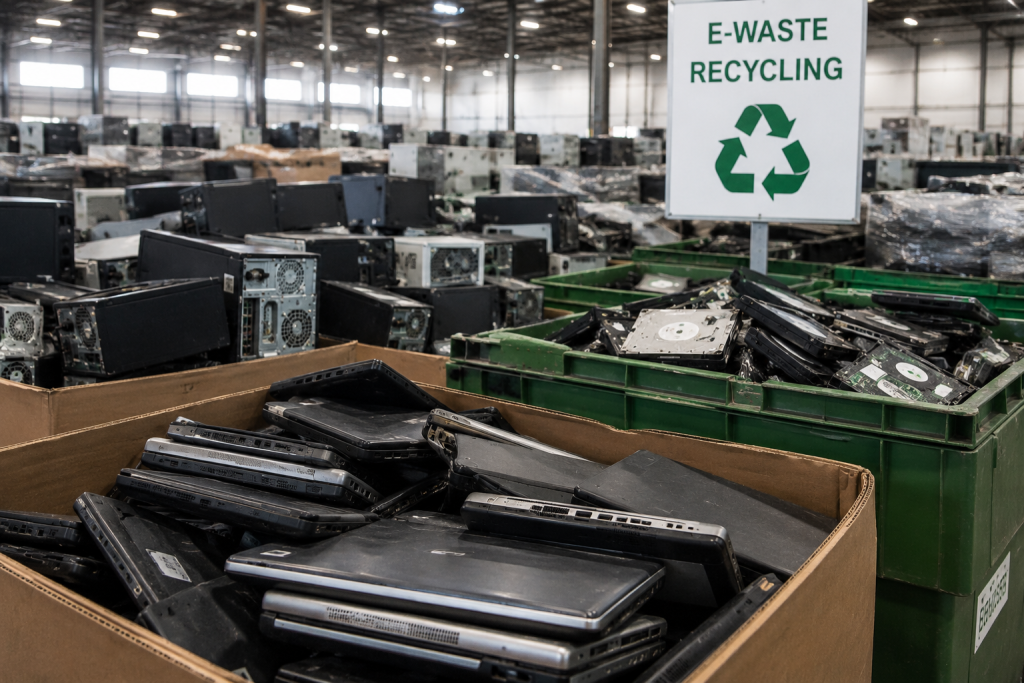
E-waste (electronic waste) is any device with a battery, cord, or circuit board that has reached the end of its usable life. If it plugs in, plugs into something else, or runs on a battery, it’s almost always covered.
For businesses, the most common categories include:
- IT and data center hardware — servers, storage arrays, networking switches and routers, UPS units, and backup tapes
- End-user devices — desktops, laptops, tablets, and monitors
- Peripherals — keyboards, mice, printers, scanners, and copiers
- Telecommunications equipment — VoIP phones, PBX systems, and cabling hardware
- Circuit boards, memory, and CPUs pulled during hardware refreshes
- Large appliances with electronic components, such as commercial refrigeration or HVAC control units
A useful rule of thumb: if a device contains a circuit board, battery, or screen, treat it as e-waste until a certified recycler tells you otherwise. Many of these components contain lead, mercury, cadmium, and brominated flame retardants — materials that are classified as hazardous waste under federal law when they’re discarded.
This matters for a second reason too: much of what qualifies as e-waste still has resale value. Working servers, memory, and networking equipment are frequently retired years before they’re actually obsolete, which is why a buyback or reuse evaluation should always come before recycling.
Understanding E-Waste Challenges
Businesses need to stay updated by buying and using the latest technology to maintain operational efficiency. Computing equipment, monitors, keyboards, routers, copiers, fax machines, circuits, and other electronic items are the most prevalent types of e-waste generated by data centers.
Often, old and unwanted electronics are dumped or discarded without proper waste management techniques. This approach leads to tonnes of e-waste in landfills, exposing nature and humans to hazardous situations.
Potentially toxic materials such as lead, mercury, cadmium, and brominated flame retardants are found commonly in electronic devices. Improper e-waste disposal can lead to these dangerous compounds leaking into the land and water, creating long-term damage.
When these chemicals are left to degrade in landfills or burned without control systems, they can leach into the environment, polluting water and land and harming humans and wildlife.
Mismanagement of e-waste also poses serious health dangers to workers and local people exposed to hazardous chemicals and heavy metals. When workers manually disassemble electronics, they are put at risk of coming into contact with poisonous compounds. It can cause serious health concerns like:
- Cancer
- Neurological diseases
- Respiratory troubles
WHO has stated that e-waste is the fastest-growing solid waste stream in the world.
Given the increased emphasis on regulatory compliance for e-waste management, businesses cannot afford to overlook e-waste. Proper e-waste management involves business responsibility and limiting environmental damage.
Regulatory Framework and Compliance
The financial and environmental ramifications of careless IT disposal costs corporations millions in fines and legal action while posing health concerns to the public. This situation has made the appropriate management of electronic trash (e-waste) a key priority for enterprises globally.
The handling of e-waste must adhere to some legal compliance standards in the United States to encourage proper disposal and reduce environmental effects. The Environmental Protection Agency (EPA) administers the Resource Conservation and Recovery Act (RCRA), which is the principal federal statute governing e-waste disposal.
Under RCRA, some electronic gadgets disposed of are considered hazardous trash and must be handled carefully. For e.g.: the EPA promotes the recycling of CRTs to extract valuable materials.
Each state in the United States has its own set of e-waste compliance issues. As of now, legislation about electronics recycling has been passed by 25 states, including New York and California, as well as the District of Columbia.
Manufacturers and retailers bear the greater cost of responsible e-waste disposal, and numerous new rules are expected to establish or reinforce this. It implies that businesses will be responsible for the whole product life cycle, from manufacturing to disposal.
As consumers become more aware and conscious of sustainability, businesses’ brand reputations now depend on their environmentally friendly measures.
Moreover, businesses must manage their e-waste effectively to maintain data security, environmental protection, and regulatory compliance. There are also other financial benefits, such as possible cost savings and recycling money.
Business E-Waste Regulations by State
E-waste law in the U.S. is a patchwork. As of 2026, 25 states plus the District of Columbia have passed statewide e-waste legislation, meaning the other half of the country has no comprehensive e-waste law at all — though many of those states still enforce landfill bans or local ordinances.
Here’s what businesses need to understand about how these laws typically work:
Producer responsibility vs. consumer-funded programs
Most states use an Extended Producer Responsibility (EPR) model, where manufacturers fund collection and recycling. California is the notable exception — it charges a recycling fee to consumers at the point of purchase instead, through its Electronic Waste Recycling Act.
Landfill bans
A number of states including California, New York, and Illinois — ban electronics from landfills entirely. Several other states, such as Massachusetts and New Hampshire, ban specific categories like CRTs. Violating a landfill ban can carry real fines for a business, not just a warning.
Covered entities vary
Some state laws only apply to household generators. Others explicitly cover businesses, schools, and government agencies. If your organization operates in multiple states, you can’t assume the rules that apply in one location apply everywhere else.
The regulatory bar keeps rising
2026 has brought a fresh wave of activity: Washington’s right-to-repair law now requires manufacturers to widen access to parts and repair information, California expanded its e-waste program to cover more battery-embedded devices, and Vermont broadened its battery take-back requirements to include larger battery formats. Oregon added new device categories — including routers, modems, and small servers — to its existing electronics program.
What this means for multi-state businesses:
- Don’t assume your headquarters state’s rules apply company-wide
- Track which of your operating states have landfill bans, since violations there carry direct liability
- Build vendor contracts around documentation (certificates of recycling, chain-of-custody records) rather than assuming compliance
- Revisit your compliance checklist annually — state e-waste and right-to-repair laws are changing faster than they have in years
If your organization operates across state lines, the safest approach is to hold every location to the strictest applicable standard rather than trying to manage 50 different compliance thresholds individually. A documented, standardized ITAD process makes this dramatically easier to manage than handling disposal location by location.
Best Practices in E-Waste Recycling
Using best practices for managing e-waste can improve a business’s productivity and reputation. Companies can consider best practices such as audits, collection systems, certified recycling partner selection, employee engagement, and more for effective e-waste management.
As businesses become more environmentally sensitive, several electronic product makers are developing products that are more energy efficient and produce less waste. The best approach for businesses to reduce the amount of electronic trash they generate is to base their purchases on sustainability. Companies should also encourage employees to buy and discard electronic devices with more awareness.
Businesses handling electronic trash must ensure that their procedures are sustainable and responsible. It includes restoring, recycling, and properly disposing of electronic devices.
The most popular way used by businesses to handle their electronic trash is by selling old electronics to recycling companies. Electronics recycling involves breaking down old electronic products and taking the working parts to make new products.
Organizations can also buy refurbished electronics or reuse their equipment rather than discard them by repairing it. This can also save businesses money in the long run, as buying new gadgets can be expensive.
When discarding is the only option, businesses need to be mindful of how they dispose of e-waste using efficient segregation, safe storage, and transportation.
How to Find an R2/e-Stewards Certified Recycler
Not every company that advertises “e-waste recycling” actually recycles responsibly. Some simply export unprocessed electronics overseas, where they’re dismantled under conditions that would be illegal in the U.S. Certification is how you tell the difference.
The EPA recognizes two accredited certification standards for electronics recyclers:
- R2 (Responsible Recycling), now in its R2v3 version — developed by Sustainable Electronics Recycling International (SERI). R2v3 covers data security, worker safety, environmental controls, and downstream material tracking, and uses appendices to certify facilities for specific work, such as enhanced data destruction or ITAD/refurbishment.
- e-Stewards — developed by the Basel Action Network (BAN). e-Stewards is generally considered the stricter standard on one specific point: it prohibits exporting hazardous e-waste to developing countries, even when the destination country would otherwise allow it.
Here’s a practical process for vetting a recycler:
-
Search the official directories, not just Google results: Use SERI’s R2 facility finder and the e-Stewards recycler locator to search by company name and location.
- Confirm the certification is current: Certifications require annual surveillance audits, and a company’s status can lapse between updates. Ask the recycler directly for their current certificate rather than relying solely on marketing claims.
- Check for complementary certifications: NAID AAA (for data destruction), ISO 14001 (environmental management), and ISO 27001 (information security) all signal a more mature, audited operation when paired with R2 or e-Stewards.
- Ask what happens downstream: A responsible recycler should be able to explain, in specific terms, where materials go after processing — not just say “we recycle everything responsibly.”
- Request sample documentation: Ask to see a sample certificate of recycling and certificate of data destruction before you sign a contract, not after your first shipment.
- Confirm data destruction methods match your risk level: If you’re handling regulated data (healthcare, finance, government), verify the recycler follows NIST 800-88 compliant destruction and offers physical destruction, not just software wiping, for high-sensitivity drives.
A properly certified recycler will never hesitate to hand over documentation. If a vendor is vague about certification status or downstream handling, treat that as a warning sign, not a formality to skip.
Partnering with the Right Recycler
Choosing the right recycling facility for your electronic waste recycling is essential to ensure that waste is handled professionally.
Before handing your old electronic equipment to an e-waste collection and recycling center, you should consider its recycling program, reputation, and track record. It’s important to check and verify that the recycler has all necessary e-waste recycling certifications and ensure that the recycler meets industry requirements.
Look for e-waste recyclers with industry-leading certifications. These certificates demonstrate a commitment to quality in e-waste management and secure IT asset disposal. Also, consider their accessibility and transportation options for large electronic waste.
Responsible Recycling (R2) is the most widely recognized accreditation for recycling. In addition, you should confirm that the recycler follows data security and environmental requirements, such as ISO 27001 and ISO 14001.
A qualified e-waste recycling company must provide safe data erasing and practice physical destruction of storage devices like hard drives. You can also ask for certificates that guarantee adequate data-cleaning processes.
Certified recyclers provide secure data deletion services that ensure the safety of your personal and commercial information. So you won’t have to worry about your information falling into the wrong hands. They are always transparent about their recycling process and can tell you all the steps of their e-waste disposal process.
A certified e-waste recycler follows all safety measures, extracting and reusing valuable materials and carefully disposing of hazardous waste.
They implement the norms and standards established by national and international organizations addressing e-waste and follow all applicable legislation. So, you won’t have to be concerned about the safe disposal of e-waste or legal issues.
Towards Zero E-Waste with We Buy Used IT Equipment
A vital aspect of smart e-waste management is forming partnerships with accredited e-waste drop-off and recycling facilities. These facilities recover valuable resources and reduce the environmental impact to ensure that electronic gadgets get recycled in an ecologically conscious manner.
Are you making the right e-waste management decisions for your business and the environment?
If you’re looking for safe and legal e-waste recycling options, We Buy Used IT Equipment can help.
Beyond its positive environmental effects, recycling e-waste has many other advantages for organizations, including cost savings, data security, compliance, and corporate social responsibility.
Start recycling your e-waste with We Buy Used IT Equipment!
Frequently Asked Questions
What items count as e-waste for a business?
Any electronic device with a circuit board, battery, or screen counts as e-waste once it’s retired — this includes servers, laptops, monitors, networking equipment, backup tapes, and peripherals like printers and copiers. If a device plugs in or runs on a battery, it should be handled through certified e-waste channels rather than general trash.
Which states have e-waste recycling laws for businesses?
As of 2026, 25 states plus Washington, D.C. have statewide e-waste legislation, including California, New York, and Illinois, which tend to have the most comprehensive programs. Coverage varies — some laws apply only to households, while others explicitly include businesses, schools, and government agencies, so it’s important to check the specific rules in every state where you operate.
How do I verify a recycler is R2 or e-Stewards certified?
Search the official SERI R2 facility finder or the e-Stewards recycler locator by company name and location, then ask the recycler for a current certificate directly, since certifications require annual audits and can lapse. Pairing R2 or e-Stewards with NAID AAA or ISO certifications is a strong signal of a mature, well-audited operation.
Is it illegal to throw away old computers or servers?
In states with landfill bans on electronics — including California, New York, and several others — disposing of computers, monitors, or servers in regular trash is illegal and can carry fines. Even where no ban exists, doing so creates data security risk and environmental liability, so certified recycling is the safer route regardless of location.
What’s the difference between R2 and e-Stewards certification?
R2v3 focuses heavily on data security, worker safety, and downstream material tracking through a flexible, appendix-based structure. e-Stewards places extra emphasis on preventing the export of hazardous e-waste to developing countries. Many top-tier recyclers hold both certifications to cover the full range of compliance requirements.
Should I sell old IT equipment instead of recycling it?
If the equipment still functions, selling or refurbishing it is almost always the better option financially and environmentally, since reuse avoids the resource cost of full recycling. Recycling should be reserved for hardware that’s genuinely beyond its useful life or unsellable due to age or damage.