Skip to content
Facebook Instagram X-twitter Youtube Linkedin

West Coast: (800) 700-7683 — East Coast: (800) 821-1782 — 9033 9th St. Rancho Cucamonga, CA 91730

We Buy Used IT Equipment
Powered By DES
  • Sell Your Equipment
    • Servers
      • Cisco
      • Dell
      • IBM
      • HP
      • Lenovo
      • SuperMicro
    • Backup Tapes
      • LTO Tapes
        • LTO10
        • LTO9
        • LTO8
        • LTO7
        • LTO6
        • LTO5
        • LTO4
        • LTO3
        • LTO Cleaning Tape
      • 3592 Tapes
        • 3592 JK
        • 3592 JE
        • 3592 JD
        • 3592 JC
        • 3592 JB
        • 3592 JA
      • T10k T2 Tapes
      • MLR/SLR Tapes
        • IBM MLR1 SLR32
        • Imation SLR32
        • Sony SLR5
        • Tandberg SLR
        • MLR/SLR Cleaning Tape
      • 4mm Tapes
        • DDS7 – DAT320
        • DDS6 – DAT160
        • DDS5 – DAT72
        • DDS4 – DAT40
      • 8mm VXA Tapes
    • Data Storage
      • Hard Drives
        • HGST
        • Hitachi
        • HP
        • IBM
        • Kingston
        • Samsung
        • Seagate
        • Toshiba
        • Western Digital
      • Storage Arrays
    • Networking
      • Routers
      • Switches
    • VoIP and Telecom
    • Memory
      • Server Memory
      • Laptop Memory
      • Desktop Memory
      • DDR3
      • DDR4
      • DDR5
    • CPUs and Processors
      • Intel Core
      • Intel Xeon
      • AMD
    • Laptops
      • Apple
      • Asus
      • Dell
      • HP
      • IBM Lenovo
      • Samsung
      • Toshiba
    • Tape Drives and Libraries
    • SFP Transceivers
      • Cisco SFP Transceivers
      • HPE SFP Transceivers
    • Scrap Electronics
    • Submit Your List
  • Services
    • Secure IT Asset Disposition
      • Secure Shipping
    • Data Center Services
      • Takeouts
      • Relocation
      • Liquidation
      • Other On-Site Services
    • Data Destruction
      • Data Destruction Compliance
        • Certificate of Data Destruction
        • Physical Data Destruction
        • Permanent Data Erasure
        • Magnetic Degaussing
      • Data Tape Erasure
      • Hard Drive Disposition
        • Hard Drive Sanitization
    • Electronics Recycling
    • Global Advantage Partner
    • Donate to Charity
  • Buy Equipment
    • Backup Tape
    • Data Center Equipment
    • New Equipment
    • Refurbished Equipment
      • Refurbished Servers
    • Warranty Information
  • Lifecycle & Sustainability
    • Lifecycle Services
      • Secure IT Asset Disposition
      • Electronics Recycling
      • Donate IT Equipment to Charity
      • Our ITAD Process
      • Secure Equipment Shipping
    • Resources
      • IT Equipment Recycling
      • E Waste Recycling
      • IT Asset Disposition Guide
      • Data Center Decommissioning
      • Comprehensive Guide to ITAD
      • Guide to Donating IT Equipment to Charity
  • Blog
  • About Us
    • Contact Us
    • Our Processes
    • ITAD White Paper
    • Newsletter
    • References
    • Privacy Policy
    • FAQ
    • Sitemap
  • Get A Quote
  • Sell Your Equipment
    • Servers
      • Cisco
      • Dell
      • IBM
      • HP
      • Lenovo
      • SuperMicro
    • Backup Tapes
      • LTO Tapes
        • LTO10
        • LTO9
        • LTO8
        • LTO7
        • LTO6
        • LTO5
        • LTO4
        • LTO3
        • LTO Cleaning Tape
      • 3592 Tapes
        • 3592 JK
        • 3592 JE
        • 3592 JD
        • 3592 JC
        • 3592 JB
        • 3592 JA
      • T10k T2 Tapes
      • MLR/SLR Tapes
        • IBM MLR1 SLR32
        • Imation SLR32
        • Sony SLR5
        • Tandberg SLR
        • MLR/SLR Cleaning Tape
      • 4mm Tapes
        • DDS7 – DAT320
        • DDS6 – DAT160
        • DDS5 – DAT72
        • DDS4 – DAT40
      • 8mm VXA Tapes
    • Data Storage
      • Hard Drives
        • HGST
        • Hitachi
        • HP
        • IBM
        • Kingston
        • Samsung
        • Seagate
        • Toshiba
        • Western Digital
      • Storage Arrays
    • Networking
      • Routers
      • Switches
    • VoIP and Telecom
    • Memory
      • Server Memory
      • Laptop Memory
      • Desktop Memory
      • DDR3
      • DDR4
      • DDR5
    • CPUs and Processors
      • Intel Core
      • Intel Xeon
      • AMD
    • Laptops
      • Apple
      • Asus
      • Dell
      • HP
      • IBM Lenovo
      • Samsung
      • Toshiba
    • Tape Drives and Libraries
    • SFP Transceivers
      • Cisco SFP Transceivers
      • HPE SFP Transceivers
    • Scrap Electronics
    • Submit Your List
  • Services
    • Secure IT Asset Disposition
      • Secure Shipping
    • Data Center Services
      • Takeouts
      • Relocation
      • Liquidation
      • Other On-Site Services
    • Data Destruction
      • Data Destruction Compliance
        • Certificate of Data Destruction
        • Physical Data Destruction
        • Permanent Data Erasure
        • Magnetic Degaussing
      • Data Tape Erasure
      • Hard Drive Disposition
        • Hard Drive Sanitization
    • Electronics Recycling
    • Global Advantage Partner
    • Donate to Charity
  • Buy Equipment
    • Backup Tape
    • Data Center Equipment
    • New Equipment
    • Refurbished Equipment
      • Refurbished Servers
    • Warranty Information
  • Lifecycle & Sustainability
    • Lifecycle Services
      • Secure IT Asset Disposition
      • Electronics Recycling
      • Donate IT Equipment to Charity
      • Our ITAD Process
      • Secure Equipment Shipping
    • Resources
      • IT Equipment Recycling
      • E Waste Recycling
      • IT Asset Disposition Guide
      • Data Center Decommissioning
      • Comprehensive Guide to ITAD
      • Guide to Donating IT Equipment to Charity
  • Blog
  • About Us
    • Contact Us
    • Our Processes
    • ITAD White Paper
    • Newsletter
    • References
    • Privacy Policy
    • FAQ
    • Sitemap
  • Get A Quote

How to Properly Manage the Data Lifecycle

Big Data, Data, Data Centers, Data Destruction, Data Privacy, Data Security, Data Storage, Information Technology, ITAD, News
  • Alex
  • December 6, 2021
  • 1:27 pm
Browse:
Home Big Data How to Properly Manage the Data Lifecycle

Earlier data were recorded on pen and paper and used to get transferred through the hands of people. For confidential data, trustworthy personnel were selected for transferring of data. Details about the time of exchange of documents were kept secret and the documents were sealed with melted wax to protect them from thieves.

Now doing the same thing now will make those workers lose all their hair. Not to forget the coding, software, and data about people traveling on a daily basis, exchanging conversations over social networking websites.

So, just like that, businesses and organizations have their individual data having details about their businesses which needs to be maintained. It is necessary and also helpful to have a data lifecycle to have more analyses, discoveries, and more due to access to large data sets.

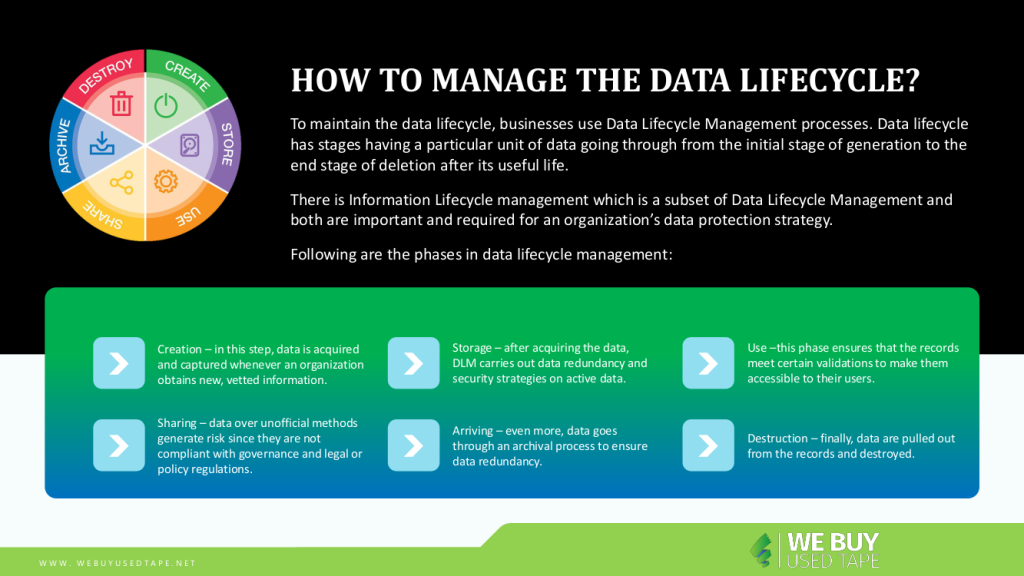
To maintain the data lifecycle, businesses use Data Lifecycle Management processes. Data lifecycle has stages having a particular unit of data going through from the initial stage of generation to the end stage of deletion after its useful life.

Data Lifecycle management can be therefore used to maintain the lifecycle of data but how? Let’s see.

What does Data Lifecycle Management do?

It involves the processes, policies, and procedures required to manage business data of an organization within it during its lifetime starting with creating or beginning of data till it’s no longer required. It is a policy-based system monitoring its operation which helps to manage the incoming and outgoing of information during its useful lifetime throughout various applications, systems, databases, and storage media.

There is Information Lifecycle management which is a subset of Data Lifecycle Management and both are important and required for an organization’s data protection strategy.

In Data Lifecycle Management, data are protected, preserved, and managed. To make the process more complex, these above-mentioned things need to be carried out under complex regulations and that too in several places. The regulations need to be followed in the places where the organization’s data are like in the premises or off the premises such as in the cloud, in remote workforce machines, etc. DLM also helps businesses to remain updated on any evolving regulations and eDiscovery requirements.

DLM helps the organizations to have control over their large number of data allowing the organization to fulfill their archiving needs, lessening the burden for IT professionals. This way, businesses can see a reduction in their storage costs, enhancing faster decision-making by improving the processing efficiency and fast recovery during an event of an emergency.
Following are some features of DLM:

DLM allows data to be more easily accessible, clean, and usable. Therefore, data-driven processes will be able to carry out more effectively thus the organization will be able to achieve higher agility and control over data.

DLM confirms that the data created or collected will be kept safe. This is possible as, under DLM regulations, it mentions the ways the data will be processed, stored, and shared which ensures the users’ data are protected by preventing the data from breaches, losses, and risk of data deletion.

Every business is different and thus has different conditions for data retention. Using DLM in businesses will ensure that the company’s data are compliant with the laws and regulations all around the world. There are compliance regulations that need to be adhered to by the companies which regulate the ways in which the organization should deal with particular types of data. If companies do not follow, then that will lead to non-compliance citations and penalties.

Companies also face great advantages when using DLM.

Following are some benefits of DLM that are enjoyed by the companies:

It helps in reducing costs or effectively using the resources. Sometimes data that is not being frequently used or doesn’t have much value remains stored in storage which can either be in high-end resources which are definitely not necessary. DLM shifts these types of data when they are not in use to a different location. Data can be transferred to the cloud or in a hosted off-site tape vault. This way the data required frequently can be easily accessed and the storage will be better utilized.

In today’s world, everything is wanted quickly. Quick access, quick payments, quick updates. To provide customer quick service, the process of acquiring data or searching of data and delivering of data needs to be quick. This way, workers to users remain productive and this is what DLM delivers. Through DLM, data can be acquired as and when required and thankfully eliminates data that will prevent essential business collaboration. When data are extracted and maintained during the whole time through the data lifecycle, values are effectively updated and always available.

Securing data is very crucial and it is no secret now. We hear small to large breaches and from small big companies, every company gets affected by it. DLM incorporates data protection being its core capabilities which in turn will protect the data infrastructure.

DLM strategy helps to maintain tagged and indexed data so that they can be accessed whenever required. DLM strategy will work with IT to bring new policies and procedures for the same. When data are established through governance policies, it protects the data for the future since the data can be retained as long as required. It is beneficial to have clean, useful, and precise data as these will enhance the users’ experience increasing the agility and efficiency of the company process.

  • It recognizes and reduces process and data bottlenecks.
  • It keeps redundancy under check by carrying out accurate identification of duplicate records.
  • It is capable to run root-cause analysis.
  • DLM is able to trace data lineage across the customer demographic lifecycle.
  • It increases efficiency in managing historical data.
  • It helps in reducing unwanted changes to data content.
  • It also develops better consistency, reliability, and access to needed data.
  • For the companies to have these benefits, DLM follows a process.
https://youtu.be/3cITudz5T9M

Following are the phases in Data Lifecycle Management:

Creation – in this step, data is acquired and captured whenever an organization obtains new, vetted information. The information could include creating data internally, purchasing third-party data, and collecting data as it streams. It handles every format of data.

Storage – after acquiring the data, DLM carries out data redundancy and security strategies on active data. This step prevents data from being altered accidentally. This is the time when the data gets secured so that it can be accessed by those who are authorized. This will help the organization to protect its intellectual property along with its customer relationships. This phase is also crucial since it is not only important to have a place to store but also it should be possible to retrieve the data if lost and DLM is capable of data recovery plans.

Use – further in the phase, this phase ensures that the records meet certain validations to make them accessible to their users based on some definitions given by DLM.

Sharing – data are shared on a daily basis. Data can be shared with someone who is from the organization to another person from the organization but data can also be shared with another person who does not belong to the organization. Sharing data over unofficial methods generate risk since they are not compliant with governance and legal or policy regulations.

Arriving – even more, data goes through an archival process to ensure data redundancy. This is an ideal storage method that helps organizations to store huge amounts of data and allow the organizations to access the information when required.

Destruction – finally, data are pulled out from the records and destroyed.

Browse:
Home Big Data How to Properly Manage the Data Lifecycle

Get A Quote

Phoenix Certified
Fill our form here
PrevPreviousBare Metal Servers vs Virtual Machines? Which is Right for You?
NextHow to Get the Best Price for Used ServersNext
Picture of Alex

Alex

Expertise With over 15 years of experience in marketing and business development, Alex is a seasoned strategist in digital marketing, content creation, and brand growth, Ge has grown as a trusted voice in the technology and business sectors over the past decade. Education Alex holds a Master’s degree in Entrepreneurship and dual Bachelor’s degrees in Marketing and Entrepreneurial Management from California State University - San Bernardino. Experience Alex has led high-impact initiatives that have driven significant revenue growth, brand expansion, and customer engagement. His work includes managing e-commerce operations, optimizing digital advertising strategies, and developing content that educates and informs professionals about technology and business trends. Outside of Work Beyond his professional endeavors, Alex enjoys staying active and spending quality time with family.
All Posts

Client
Testimonials

“The buyback program was easy for me to use. I simply sent WEBUY an email with the list of surplus items that I had. WEBUY replied back with a quoted value. I then shipped WBUY the tapes and quickly received payment. The process was very easy and I felt good that I wasn’t throwing the equipment into the landfill and someone else can make use of them.

I will do business with WBUY again.”

Bay Industries Inc.

“I have to say once I found you the process was relatively quick and straightforward. Your website provided great details and once I submitted my inventory within 24 hours I had a quote and confirmation of the dollar amount.

The entire process from shipment to check in hand was painless and quick, I will most definitely use this service again and have already recommended it to my other peers.”

Masons of California

Subscribe to our newsletter

Your inbox deserves better. Sign up for regular updates, insights, and deals!

  • Sorry, this service is unavailable in your country.

  • Should be Empty:
Visit Us
  • 9th St. Rancho Cucamonga, CA 91730
  • West Coast: (800) 700-7683
  • East Coast: (800) 821-1782
  • Local: (909) 466-7680
We Buy Used IT Equipment

Powered By DES

Facebook Instagram X-twitter Youtube Linkedin
BUY EQUIPMENT
  • Backup Tape
  • New Equipment
  • Refurbished Equipment
  • Warranty Info
  • Backup Tape
  • New Equipment
  • Refurbished Equipment
  • Warranty Info
SELL EQUIPMENT
  • Servers
  • Backup Tape
  • Removable Storage
  • Telecom & VOIP
  • Networking & Switches
  • Memory
  • CPUs and Processors
  • Laptops
  • Tape Drives
  • SFP Transceivers
  • Scrap Electronics
  • Servers
  • Backup Tape
  • Removable Storage
  • Telecom & VOIP
  • Networking & Switches
  • Memory
  • CPUs and Processors
  • Laptops
  • Tape Drives
  • SFP Transceivers
  • Scrap Electronics
SERVICES
  • IT Asset Disposition
  • Data Destruction
  • Data Center Services
  • Secure Shipping
  • Donate Your Assets
  • International Sales
  • Onsite Services
  • Electronics Recycle
  • IT Asset Disposition
  • Data Destruction
  • Data Center Services
  • Secure Shipping
  • Donate Your Assets
  • International Sales
  • Onsite Services
  • Electronics Recycle
STAY INFORMED
  • Blog
  • About Us
  • Contact Us
  • Our Process
  • FAQ
  • Sitemap
  • Blog
  • About Us
  • Contact Us
  • Our Process
  • FAQ
  • Sitemap

© 2026 All Rights Reserved. Website created with ❤ by mrrssy.

Accessibility Adjustments

Powered by OneTap

How long do you want to hide the toolbar?
Hide Toolbar Duration
Select your accessibility profile
Vision Impaired Mode
Enhances website's visuals
Seizure Safe Profile
Clear flashes & reduces color
ADHD Friendly Mode
Focused browsing, distraction-free
Blindness Mode
Reduces distractions, improves focus
Epilepsy Safe Mode
Dims colors and stops blinking
Content Modules
Font Size

Default

Line Height

Default

Color Modules
Orientation Modules