
Blog

Whether you’re a business looking to recover value from retired assets or an individual hunting for affordable tech, our guides and insights help you make smarter decisions in the IT resale market.

Category: Data Destruction

Certified Hard Drive Destruction Workstation
Data Destruction
Dakodah

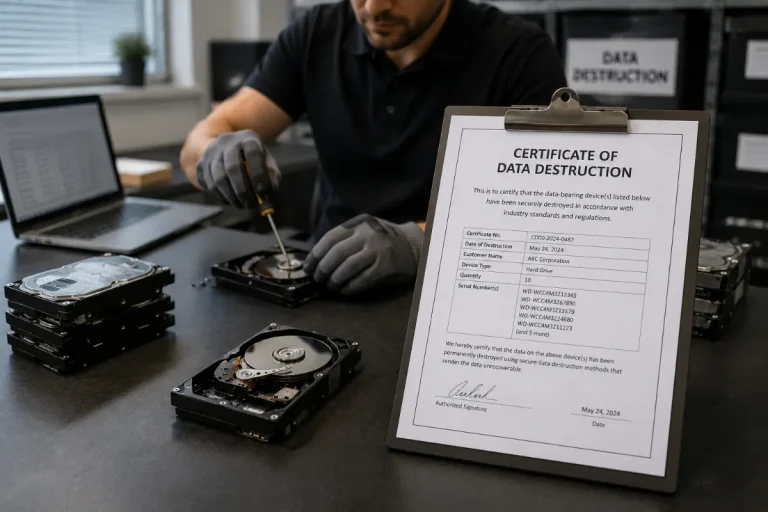
What Is a Certificate of Data Destruction?

A certificate of data destruction is written proof that data-bearing equipment was erased, sanitized, or destroyed. It helps show what was processed, when it happened, how it was done, and who completed the work. That proof matters. Retired laptops, servers, hard drives, SSDs, backup tapes, storage arrays, and mobile devices may still hold sensitive data. If your business sells, recycles, donates, or disposes of that equipment without documentation, questions can come later. An auditor, customer, insurer, or legal team may

Server room collaboration and checklist review
Data Center Equipment Recycling
Dakodah

Data Center Decommissioning Checklist: What to Do Before You Sell or Recycle Your Equipment

If you’re planning a data center decommission, don’t unplug equipment and hope for the best. A structured decommissioning process protects sensitive data, reduces downtime, maximizes resale value, and ensures responsible recycling. This checklist walks you through every step before you sell or recycle your IT equipment. Why a Data Center Decommissioning Checklist Matters A data center decommissioning project involves much more than removing old servers from a rack. Every asset contains value, sensitive information, and environmental responsibility. Without a clear

It pro and Standards for Tape Media Destruction
Data Destruction
Alex

Erase It Right: Modern Standards for Secure Tape Media Destruction

Enterprise tape media is far from obsolete. LTO cartridges, enterprise tape libraries, and archival storage systems still protect some of the most sensitive data in the world—financial records, healthcare data, government archives, and long-term backups. Yet when tape media reaches end of life, many organizations underestimate the risk of improper erasure or destruction. Unlike hard drives, tape data cannot always be erased with a single command. And unlike cloud storage, tape media remains a physical asset that can be lost,

data destruction
Data Destruction
Kathy

Hard Drive Destruction in San Diego: How to Safely and Securely Dispose of Old Data

Key Takeaways: Why Hard Drive Destruction Matters Retiring an old server or hard drive and simply hitting delete can become a severe liability in today’s heavily regulated landscape.   The San Diego business community—from hospitals and universities to financial firms and fast-growing tech companies—faces a significant challenge: responsibly handling sensitive data. Regulations like HIPAA, CCPA, and the Gramm-Leach-Bliley Act make it evident that data security compliance should not be overlooked. At the same time, sustainability goals are pushing organizations to find

on-site hard drive destruction in california
Data Destruction
Alex

On-Site Hard Drive Destruction

On-Site Hard Drive Destruction in California: The Secure, Compliant Way to Protect Your Data When your organization retires old computers, servers, or data storage devices, one question matters more than anything else: how will the data on those drives be destroyed? In today’s regulatory environment, wiping a drive isn’t always enough. Businesses throughout California are upgrading security practices to ensure complete and verifiable data destruction—especially when dealing with confidential customer data, medical records, financial information, and proprietary business systems. At

technicians performing certified eradication
Big Data
Alex

Certified Data Destruction & Secure Data Eradication for the Big Data Supply Chain

The Growing Security Risk You Can’t Ignore By 2025, global data volume is projected to surpass 180 zettabytes. For businesses, that’s more than just a staggering number—it’s a massive security liability. Whether you operate a data center, manage enterprise IT infrastructure, or simply store customer information, you are part of the Big Data supply chain. This chain spans every stage of data handling: collection, processing, storage, and, eventually, destruction. Here’s the reality:If even one retired server, LTO tape, or SSD

A technician performing secure data sanitization on enterprise storage devices.
Data
Alex

The Ultimate Guide to Data Sanitization

In today’s digital-first economy, your company’s data is one of its most valuable — and most vulnerable — assets. Whether you’re in finance, healthcare, education, or technology, the data you store holds the trust of clients, customers, and partners. But here’s the problem: too many organizations still believe that a simple delete or factory reset is enough to erase sensitive data. It’s not. And in 2025, that misunderstanding could cost you millions. This guide breaks down what data sanitization really

phoenix certified end to end solution
Data Destruction
Alex

End-to-End Solution for Tape Disposal, Data Migration & Sanitization

In today’s data-driven world, businesses must balance compliance, cybersecurity, and sustainability. Yet, aging tape archives can quietly become a ticking time bomb. Poorly handled media not only risks data breaches—it can also violate regulations and harm your brand’s reputation. That’s why organizations across healthcare, finance, and government turn to WeBuyUsedITequipment.net for an end-to-end solution for tape disposal, data migration, and sanitization. Powered by DES Technologies, our Phoenix Certified™ Process delivers total control—from inventory to final certificate. Let’s break down how

recycling tape data risk assessment
Data Destruction
Alex

The Hidden Danger of Tape Recycling: Why Data Risk Assessment Isn’t Optional

Recycling enterprise-grade storage tapes like LTO or IBM 3592 may seem like a simple, eco-conscious decision. But if you’re not conducting a proper data risk assessment before disposal, you could be walking straight into a compliance and security nightmare. At WeBuyUsedITequipment.net, we’ve spent decades in the ITAD industry helping organizations—from Fortune 500s to small data centers—securely dispose of storage media. And one truth we’ve seen time and again is this: Recycling doesn’t mean your data is gone. Before sending out

data sanitization best practices
Data Destruction
Alex

What Is Data Sanitization—and Why Should You Care?

Data sanitization is more than just deleting files or formatting a drive. It’s the process of permanently and irreversibly removing data from storage devices, ensuring it cannot be recovered or misused. For companies retiring IT assets—especially hard drives, SSDs, or magnetic tape like LTO and 3592—it’s a regulatory requirement, a cybersecurity best practice, and an ethical obligation. Unfortunately, many businesses believe they’re doing it right—until a data breach, legal demand, or failed audit proves otherwise. The Dangerous Myth of “Delete

Monitor Every Step of Tape Sanitization process
Data Destruction
Alex

Track & Trace: How to Monitor Every Step of Tape Sanitization and Destruction

In today’s digital-first world, safeguarding data doesn’t end with secure storage or encryption. The lifecycle of data must include responsible, transparent, and traceable destruction methods. As organizations across industries handle sensitive information, demonstrating accountability and compliance in how they dispose of media has become non-negotiable. This is especially true for LTO and 3592 data tapes, which are often used to archive mission-critical and regulated data. In 2025, customers, regulators, and stakeholders demand more than just data destruction—they require proof. This

tape being crushed
Data Destruction
Alex

Tape Media Shredder Risks: Hidden Risks in Tape Destruction

The Myth of Total Destruction In the data security world, few images are more satisfying than a high-powered shredder devouring a row of magnetic tapes. It feels final. It feels secure. It feels compliant. But here’s the truth you won’t hear from most ITAD vendors: Shredders aren’t perfect. And shredding alone won’t protect you from regulatory fines, data breaches, or lawsuits. This article explores the hidden risks in relying solely on tape media shredding for data destruction—and introduces a Phoenix

Search