The Myth of Total Destruction
In the data security world, few images are more satisfying than a high-powered shredder devouring a row of magnetic tapes. It feels final. It feels secure. It feels compliant.
But here’s the truth you won’t hear from most ITAD vendors:
Shredders aren’t perfect.
And shredding alone won’t protect you from regulatory fines, data breaches, or lawsuits.
This article explores the hidden risks in relying solely on tape media shredding for data destruction—and introduces a Phoenix Certified Process that solves the problem at its root.
Whether you manage IT for a government agency, a financial institution, a healthcare system, or a data-driven enterprise, understanding the limitations of shredding could save your organization from devastating liability.
Section 1: The Problem No One Wants to Talk About
“We Shred Everything” Is Not a Data Security Strategy
Every week, companies across the U.S. load pallets of LTO and 3592 tapes into shredding bins and trust a vendor to destroy them. It’s a routine that feels foolproof. After all:
- The tapes are physically destroyed.
- You get a certificate of destruction.
- The recycler is R2-certified.
But here’s the hard truth:
Shredding magnetic tape is not inherently equivalent to data sanitization.
Let’s look at why.
Section 2: The Shredder Illusion — 6 Reasons Why It’s Not Enough
- Particle Size ≠ Data Irrecoverability
Most industrial tape shredders cut tape into strips or chunks around 1.5–2 inches in length. While this may be “acceptable” under outdated guidelines, modern forensic recovery methods can reassemble strips to extract data.
Especially dangerous are cases where tapes were shredded without degaussing or prior overwriting.
- Shredders Can Malfunction or Jam
Even the best machines fail. When shredders jam or overheat mid-process, some tapes may not be fully processed. If your vendor skips visual verification or skips serial number auditing, you may never know.
- Missed Media Happens More Often Than You Think
In large destruction batches, it’s not uncommon for a few tapes to be missed or improperly destroyed. In some cases, entire batches were found un-shredded due to miscommunication between logistics and destruction teams.
- No Data Audit Trail
Most shredding services don’t document which specific tapes were destroyed. They issue a general certificate—sometimes handwritten—covering a batch of hundreds or thousands.
When auditors ask, “Which tapes were destroyed, and when?”—you’ll have no serial-level proof.
- Unverified Chain of Custody
Tape media may change hands multiple times—through carriers, staging facilities, subcontractors. If even one party lacks integrity, your tapes can be intercepted, copied, or stolen before they ever see a shredder.
- Environmental Gaps
While shredding meets some e-waste recycling standards, it often fails to meet true sustainability goals unless paired with responsible downstream recycling and full material traceability.

Section 3: Real-World Examples of Shredder Failures
💥 Defense Contractor Data Leak
A defense subcontractor sent LTO-7 tapes to a shredding vendor. Later, 3 of those tapes were recovered—unshredded—in a warehouse 400 miles away. They were apparently removed by a subcontracted logistics driver.
Result: Internal audit, loss of contract, and ongoing federal investigation.
🏥 HIPAA Violation via Improper Shredding
A healthcare provider shredded tapes containing PHI but didn’t verify whether the shredding met HIPAA-required destruction standards. After a random inspection, they were fined $1.3 million for improper data handling.
🧑⚖️ Litigation Hold Violated
A legal services firm destroyed a batch of LTO tapes under a general shredding certificate during an ongoing case. Since they lacked tape-specific logs, they couldn’t prove compliance with litigation hold requirements.
Result: $600,000 in sanctions.
Section 4: The Compliance Problem
If you’re subject to any of the following, shredding alone is likely insufficient:
- NIST 800-88 Rev. 1
- HIPAA Security Rule
- SOX (Sarbanes-Oxley)
- GLBA
- PCI DSS
- GDPR
- CJIS
Each of these frameworks requires traceable, verifiable, and effective destruction of sensitive media. None of them consider “we shredded it, probably” to be an acceptable answer during an audit.
In fact, NIST 800-88 states that “purge or destroy” methods must include audit trails and validation.
That means you need more than a shredder—you need a process.
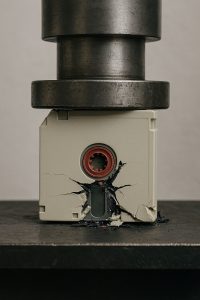
Section 5: Enter the Phoenix Certified Process™, WeBuyUsedITequipment.net (powered by DES Technologies)
DES Technologies has spent three decades perfecting data destruction solutions—and we’ve seen firsthand the failure points of standard shredding. That’s why we developed the Phoenix Certified Process™.
It’s more than destruction. It’s certified, traceable sanitization from pickup to final recycling.
🔐 Phoenix Process Pillars
- Secure Chain-of-Custody
- Tapes are scanned at pickup with unique identifiers.
- GPS-verified transport tracking.
- No subcontracted logistics.
- Serial-Level Auditing
- Every tape is logged by serial number and volume ID barcode label (Volser).
- Chain of custody and destruction certificate issued per serial number.
- Multi-Layer Sanitization
- Our system will not allow any tapes to be wiped unless they have been scanned and approved for data destruction
- Our proprietary tape wiping units degauss to NSA standards
- Software-based NIST 800-88 Clear or Purge is applied when supported.
- Physical destruction follows only after these sanitization steps.
- Shredding with Evidence
- High-security industrial shredders reduce tape to ≤1″ particles.
- Destruction is documented with timestamped photos and video.
- Witnessed destruction is available on request.
- Verified Recycling
- All shredded material is downstreamed to certified recyclers.
- Sustainability reports available for ESG compliance.
Section 6: What Shredding-Only Vendors Won’t Tell You
Many ITAD companies rely on shredding because it’s:
- Cheaper
- Quicker
- Easier to outsource
But they won’t tell you:
- Whether they audit individual tapes
- Whether their degaussing and shredding equipment meets NSA or NIST guidelines
- Where the shredded material ends up
- Whether tapes are ever resold or refurbished
That’s not destruction. That’s outsourced risk.
Section 7: How to Vet Your Destruction Vendor — A Risk Checklist
Before you sign another shredding agreement, ask your vendor these seven critical questions:
| Question | Why It Matters |
|---|---|
| Can you provide serial-level logs for every tape? | Auditable proof |
| Do you perform NIST 800-88 Clear or Purge before destruction? | Ensures compliance |
| Is the destruction witnessed, recorded, and timestamped? | Accountability |
| What is the final particle size for shredded tape media? | Data irrecoverability |
| Do you provide GPS-tracked pickup and transport? | Chain-of-custody security |
| Are all downstream recyclers R2v3 or e-Stewards certified? | Environmental compliance |
| Do you ever resell used tapes or outsource destruction to others? | Conflict of interest |
Section 8: Who’s Most at Risk?
You’re especially vulnerable if your organization handles:
- Patient Records (PHI)
- Legal Discovery Evidence
- Financial Data (PCI, GLBA)
- Trade Secrets / Intellectual Property
- Military or Law Enforcement Archives
- Client Contracts / Internal HR Records
Shredding may seem like the end—but for you, it could be the beginning of a breach.
Section 9: What the Future Looks Like — Is Shredding Obsolete?
With advances in tape sanitization tools and forensic recovery, some experts believe physical shredding will soon be replaced by multi-layer data-neutralization technologies.
Until then, the industry’s best practice is clear:
Only destroy a tape after it has been digitally verified as sanitized and audited.
That’s what the Phoenix Certified Process delivers.
Section 10: Final Thoughts — When “Destroyed” Isn’t Enough
In 2025 and beyond, regulators, insurers, and data privacy advocates are no longer satisfied with vague destruction claims.
They want proof. They want transparency.
They want more than a “we shredded it” shrug.
If you’re trusting tape shredding alone, you’re leaving gaps—and those gaps are where reputations are destroyed.
Instead, choose a process designed for compliance, not just convenience.
Need Help?
WeBuyUsedITequipment.net provides secure, compliant destruction of LTO and 3592 tapes using our Phoenix Certified Process™, backed by NIST 800-88 standards, full audit trails, and environmentally responsible recycling.
📞 Contact us for a free assessment of your tape destruction protocols—or to schedule a secure pickup anywhere in the world.
Get in Touch:
WeBuyUsedITequipment.net (powered by DES TECHNOLOGIES)
📧 sales@webuyuseditequipment.net
📞 (855) WE-BUY-TAPE (855-932-8982), 001-909-466-7682
🌐 www.webuyuseditequipment.net