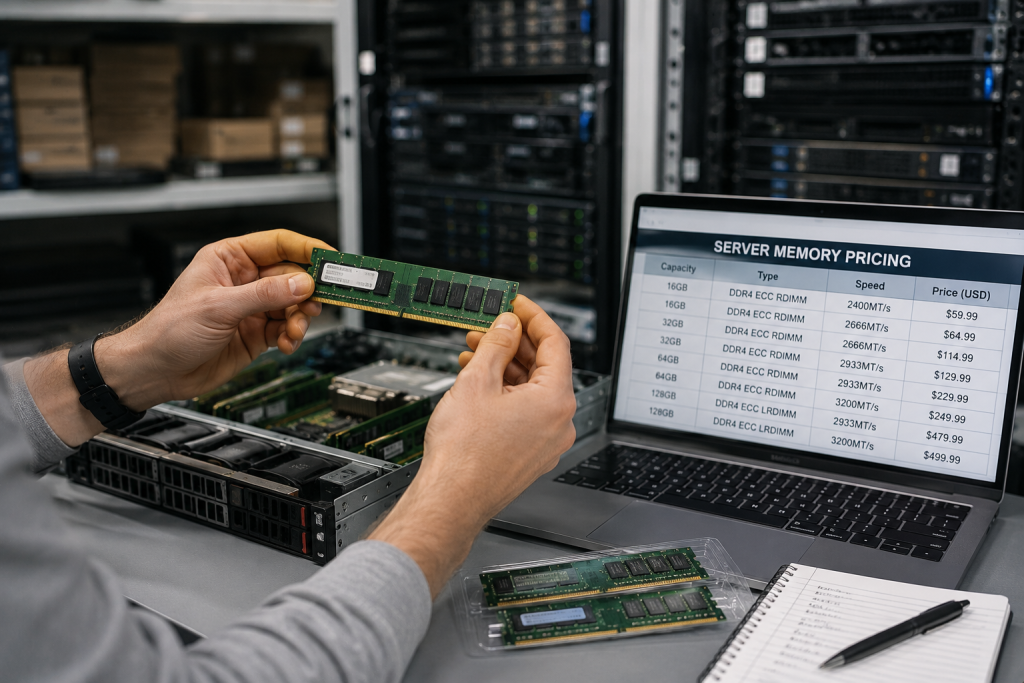
Server memory pricing depends on more than capacity. A 64GB DIMM may be valuable in one generation, ordinary in another, and hard to sell if the part number has weak demand. Buyers look at the full picture: generation, capacity, speed, type, manufacturer, quantity, condition, and current enterprise demand.
If your organization is selling server memory from a data center refresh, server decommission, office cleanout, or hardware upgrade, a clear inventory can help you get a faster and more accurate quote.
We Buy Used IT Equipment purchases enterprise server memory in small lots, bulk lots, and full data center quantities. This guide explains how server memory pricing works and what details matter most when you request a buyback quote.
What Drives Server Memory Pricing?
Server memory pricing is based on market demand and technical compatibility. Buyers are not only asking, “How many gigabytes is it?” They are asking, “Who still needs this exact module, and how quickly can it be resold?”
The strongest pricing usually comes from memory that is:
- Enterprise-grade
- Tested or pulled from working systems
- High capacity
- In current demand
- Easy to identify by part number
- Available in matching quantities
- Compatible with common server platforms
- Clean, undamaged, and properly packed
Memory that is older, low capacity, damaged, mixed without labels, or difficult to identify may still have value, but it often requires more review.
The Main Factors That Affect Server Memory Value
| Pricing Factor | Why It Matters | Seller Tip |
|---|---|---|
| Generation | DDR3, DDR4, and DDR5 do not have the same demand curve | Sort memory by generation before sending a quote request |
| Capacity | Higher-capacity DIMMs often bring stronger demand | List capacity per module, not just total capacity |
| Type | RDIMM, LRDIMM, ECC UDIMM, and NVDIMM serve different systems | Include memory type when possible |
| Speed | Speed affects compatibility and demand | Include labels such as PC4-2666V, PC4-2933Y, or PC5 speeds |
| Manufacturer | Samsung, Micron, SK hynix, Kingston, Dell, HPE, Cisco, Lenovo, and IBM labels can affect value | Take clear photos of module labels |
| Part number | Part numbers help buyers match exact demand | Provide manufacturer and OEM part numbers |
| Quantity | Larger matching lots are easier to quote and resell | Group matching modules together |
| Condition | Bent modules, missing labels, or unknown pulls lower confidence | Separate damaged or questionable memory |
| Current demand | Market demand changes by platform, refresh cycle, and supply | Request a current quote instead of relying on old pricing |
DDR3, DDR4, and DDR5 Pricing Differences
DDR3 Server Memory
DDR3 server memory can still have resale value, especially in larger quantities or higher-capacity configurations. Many organizations still maintain legacy systems for specific workloads, lab environments, industrial systems, and long-running applications.
That said, DDR3 pricing is more selective. Smaller capacities may have limited demand. Higher-capacity DDR3 RDIMMs and LRDIMMs may perform better, especially when modules are sorted by part number and quantity.
DDR4 Server Memory
DDR4 is still one of the strongest categories in the used server memory market. Many active enterprise servers use DDR4, and organizations continue to buy it for virtualization hosts, repairs, spare inventory, storage systems, and platform life extension.
DDR4 pricing often depends on capacity and speed. Common enterprise modules include 16GB, 32GB, 64GB, and 128GB DIMMs. Higher-capacity DDR4 RDIMMs and LRDIMMs often receive stronger interest.
If you have DDR4 lots ready to sell, review our Sell DDR4 Memory page for the details buyers need.
DDR5 Server Memory
DDR5 is newer in the secondary market. Pricing can be strong for high-capacity server modules, especially when demand is tied to newer enterprise platforms, AI infrastructure, virtualization, and cloud refresh projects.
Because DDR5 is still moving through newer deployment cycles, pricing can shift quickly. Sellers should include part numbers, capacity, speed, manufacturer, and photos so buyers can quote accurately.
Server Memory Type Matters
Not all server memory is priced the same. The module type affects compatibility and resale demand.
Common memory types include:
- ECC UDIMM: Often used in workstations and entry-level servers.
- RDIMM: Common in enterprise servers and widely traded.
- LRDIMM: Used for higher memory density in larger server builds.
- NVDIMM: More specialized and often quoted case by case.
- OEM-labeled memory: Dell, HPE, Cisco, Lenovo, IBM, and other labels may be useful for specific platform buyers.
RDIMM and LRDIMM modules often carry stronger demand than basic desktop RAM because they support enterprise infrastructure. Matching lots also matter. A tray of identical 64GB RDIMMs is easier to quote than a box of mixed modules with no labels.
Why Capacity Has a Big Impact on Pricing
Capacity is one of the first things buyers review. Larger DIMMs often help organizations extend server life without buying new systems. That makes high-capacity memory useful for:
- Virtualization
- Databases
- Analytics
- AI and machine learning support systems
- Storage appliances
- High-performance computing
- Cloud and hosting environments
- Enterprise platform upgrades
For DDR4 and DDR5, higher-capacity modules often receive stronger buyback interest than smaller modules. For DDR3, capacity still matters, but demand may be more limited and more dependent on the exact part number.
Speed, Rank, and Compatibility
Speed matters because server platforms require compatible memory. Buyers may look for exact specs such as:
- PC3 or PC3L for DDR3
- PC4-2133P, PC4-2400T, PC4-2666V, PC4-2933Y, or PC4-3200AA for DDR4
- PC5 speed details for DDR5
- Single-rank, dual-rank, quad-rank, or octal-rank details
- ECC, registered, or load-reduced support
If you are not sure what these labels mean, send clear photos of both sides of the module. The label usually gives buyers enough information to identify the part.
Manufacturer and OEM Labeling
Manufacturer and OEM labeling can affect server memory pricing. Modules from Samsung, Micron, SK hynix, Kingston, Crucial, Nanya, and Smart Modular may have broad demand. OEM-labeled modules from Dell, HPE, Cisco, Lenovo, IBM, and Supermicro may also attract buyers who need compatible replacement memory for specific server platforms.
Do not remove labels. Labels help confirm part numbers, capacity, speed, voltage, and manufacturer details. Missing labels make pricing harder and can reduce confidence.
Bulk Lots Usually Price Differently
Bulk server memory lots are often valued differently than single modules. A buyer may offer stronger pricing for a clean, organized lot because it is easier to test, count, package, and resell.
Bulk lots often come from:
- Data center decommissioning projects
- Server refreshes
- Cloud infrastructure upgrades
- Corporate hardware liquidations
- School and university refresh cycles
- Healthcare IT upgrades
- Government surplus projects
- MSP client cleanouts
If you have a large lot, sort by generation, capacity, manufacturer, and part number. A spreadsheet can speed up the quote process and help prevent lowball estimates.
What Information Gets You the Fastest Quote?
For the fastest quote, send a simple inventory list. Include:
- Memory generation: DDR3, DDR4, or DDR5
- Capacity per module
- Quantity
- Manufacturer
- OEM label, if present
- Part number
- Speed
- Type: RDIMM, LRDIMM, ECC UDIMM, or NVDIMM
- Condition
- Photos of labels
- Source system or server model, if known
- Location for pickup or shipping
You do not need a perfect list to start. But the more detail you provide, the faster buyers can identify market value.
Example: Why Two 64GB DIMMs May Price Differently
Two modules may both say 64GB, but they may not have the same resale value.
For example:
- A 64GB DDR4 LRDIMM from a common Dell or HPE server platform may have strong demand.
- A 64GB DDR3 module from a less common legacy platform may have narrower demand.
- A 64GB DDR5 RDIMM may price higher if it matches current enterprise demand.
- A 64GB module with missing labels or unknown condition may be harder to quote.
This is why capacity alone is not enough. The exact part number, platform demand, and lot quality all matter.
How Testing and Condition Affect Value
Working pulls from active systems are easier to quote than unknown parts from storage. Buyers want confidence that modules are functional, clean, and authentic.
Pricing may be affected by:
- Bent or damaged contacts
- Broken chips
- Missing labels
- Heavy dust or residue
- Unknown working condition
- Mixed trays with no sorting
- Poor packing during shipment
Pack memory in anti-static bags, trays, or protective packaging when possible. Avoid loose boxes where modules can scrape or bend.
How Server Memory Pricing Changes Over Time
Server memory pricing changes as enterprise platforms age. Demand can rise when companies extend the life of a stable platform. Demand can fall when large amounts of memory flood the secondary market after major refresh cycles.
Other pricing forces include:
- New server adoption
- Cloud refresh cycles
- OEM supply changes
- AI infrastructure demand
- Data center decommissioning volume
- Support needs for legacy systems
- Availability of matching lots
That is why a quote from six months ago may not reflect today’s market. If you are ready to sell, request a current buyback quote.
How We Buy Used IT Equipment Prices Server Memory
We Buy Used IT Equipment reviews server memory based on real market demand, technical details, condition, and lot size. Our team evaluates small quantities, bulk memory lots, and full data center refresh inventory.
We buy:
- DDR3 server memory
- DDR4 server memory
- DDR5 server memory
- ECC memory
- RDIMMs
- LRDIMMs
- NVDIMMs
- OEM-labeled memory
- Mixed enterprise memory lots
- Bulk data center memory pulls
If your memory has resale value, we provide a quote and help make the sale straightforward. If some items are too old or damaged to resell, we can still help route them through the right downstream process.
Server Memory Pricing Checklist
Before requesting a quote, use this checklist:
- Sort memory by generation.
- Group matching part numbers.
- Count the quantity of each module type.
- Take clear photos of labels.
- Separate damaged or unknown-condition modules.
- Include server models if known.
- Note whether the memory came from working systems.
- Share your project size and location.
- Ask about payment timing and shipping or pickup.
- Request a written quote.
Clean information leads to cleaner pricing.
FAQ
How is server memory pricing calculated?
Server memory pricing is based on generation, capacity, type, speed, manufacturer, part number, quantity, condition, and current market demand. Matching lots with clear labels usually quote faster.
Is DDR4 server memory still valuable?
Yes. DDR4 server memory still has strong resale value because many enterprise servers continue to use DDR4. Higher-capacity DDR4 RDIMMs and LRDIMMs often receive stronger demand.
Is DDR5 memory worth more than DDR4?
DDR5 can be worth more when it is newer, high capacity, and in demand. DDR4 can still bring strong value because it is widely used in active enterprise systems.
What server memory details do I need for a quote?
Send the generation, capacity, speed, manufacturer, part number, memory type, quantity, condition, and photos of labels. A spreadsheet is best for larger lots.
Can I sell mixed server memory lots?
Yes. You can sell mixed server memory lots, but sorting by generation, capacity, manufacturer, and part number can improve quote speed and accuracy.
Request a Server Memory Buyback Quote
Server memory pricing is not one-size-fits-all. The best way to know what your memory is worth is to send a current inventory list.
We Buy Used IT Equipment helps businesses turn retired server memory into recovered value. Send your DDR3, DDR4, DDR5, ECC, RDIMM, LRDIMM, or bulk memory list today for a fast quote.