DDR4 and DDR5 memory can both hold resale value. The better return depends on what you have, how much you have, and when you sell.
DDR4 still has strong resale demand because many enterprise servers, storage systems, and workstations continue to run on DDR4 platforms. DDR5 often carries premium value because it supports newer systems, AI infrastructure, cloud environments, and high-performance workloads.
That does not mean every DDR5 module is worth more than every DDR4 module. Capacity, speed, part number, manufacturer, condition, and quantity all matter.
If your team has surplus server RAM, do not let it sit in storage. We Buy Used IT Equipment can help you review the list, compare value, and request a quote.
Submit your memory list to see what your DDR4 or DDR5 inventory is worth.
Quick Answer: Which Has Better Resale Value, DDR4 or DDR5?
DDR5 usually has stronger premium value because it is newer and supports current enterprise platforms. DDR4 often has stronger buyer volume because it is still widely used across servers deployed over the last several years.
In plain terms:
- DDR5 may bring higher value per module when it is high-capacity, current, and in demand.
- DDR4 may move faster because more installed systems still need it.
- High-capacity RDIMMs and LRDIMMs usually perform better than low-capacity modules.
- Sorted bulk lots usually quote better than mixed, unidentified memory.
- Accurate part numbers and photos help buyers quote faster.
The best way to know is to send a list. Memory pricing changes with market demand.
DDR4 vs DDR5 Resale Value Comparison
| Factor | DDR4 Resale Value | DDR5 Resale Value |
|---|---|---|
| Market position | Mature and widely deployed | Newer and growing |
| Common demand | Repairs, upgrades, spare inventory, legacy servers | Newer servers, AI systems, cloud platforms, high-performance workloads |
| Buyer volume | Strong because many systems still use DDR4 | Growing as more enterprises standardize on DDR5 |
| Premium potential | Strong for 32GB, 64GB, and 128GB modules | Strong for 64GB, 96GB, 128GB, and 256GB modules |
| Risk of value drop | Older modules can lose value as platforms age | Early value can shift as supply increases |
| Best seller timing | Before DDR4 systems leave active use at scale | While DDR5 demand is active and supply is still limited |
DDR4 and DDR5 are not interchangeable. DDR4 fits DDR4 platforms. DDR5 fits DDR5 platforms. That compatibility divide keeps both markets active at the same time.
Why DDR4 Still Has Strong Resale Demand
DDR4 is no longer the newest memory generation, but it is still important in enterprise environments.
Many organizations continue to run DDR4-based systems because they are stable, cost-effective, and already integrated into production. That creates demand for replacement modules, repair stock, and capacity upgrades.
Common DDR4 resale drivers include:
- Server repairs
- Virtualization host upgrades
- Spare inventory
- Storage system support
- Healthcare and education hardware refreshes
- Data center decommissioning
- Legacy platform support
- Budget-conscious infrastructure planning
We Buy Used IT Equipment buys DDR4 memory from enterprise refreshes and server pulls. We also quote data center lots, school upgrades, healthcare IT projects, and hardware liquidations.
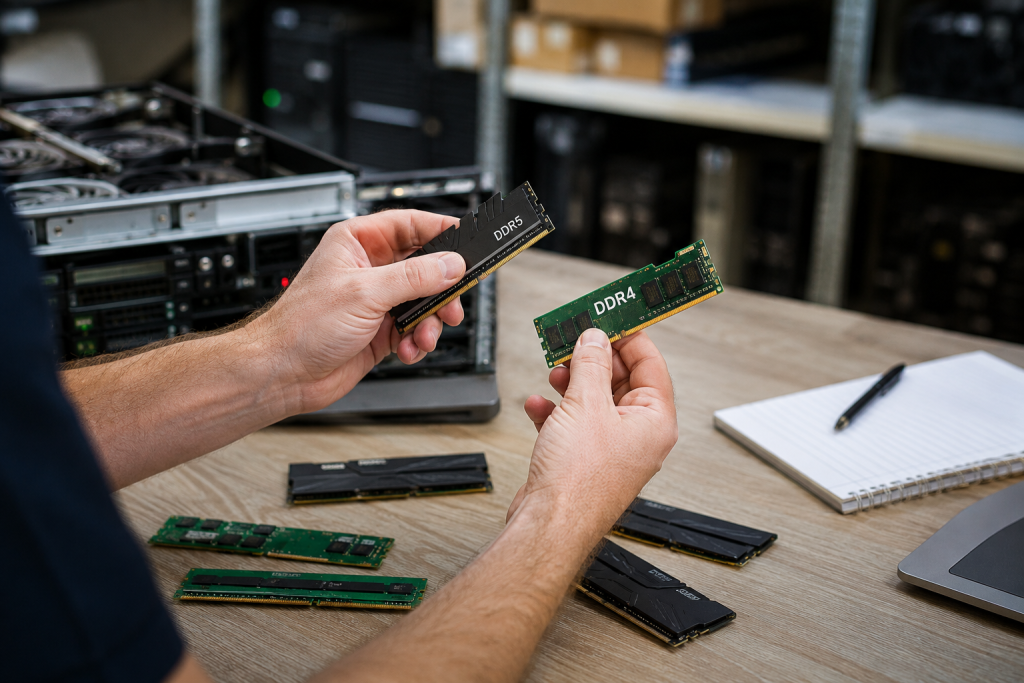
Why DDR5 Can Bring Premium Value
DDR5 is tied to newer enterprise platforms. It supports higher bandwidth, larger memory configurations, and modern workloads.
That matters for:
- AI infrastructure
- Cloud data centers
- Analytics clusters
- High-performance computing
- Newer virtualization environments
- Current-generation server refreshes
- Memory-heavy databases
Micron notes that DDR5 can provide much higher bandwidth than DDR4. Newer DDR5 RDIMM speeds and larger module densities also support modern server needs. JEDEC maintains the industry standards behind DDR memory technologies.
For sellers, this means DDR5 memory can be valuable when modules are current, high-capacity, and properly identified.
Capacity Matters More Than Most Sellers Think
Generation matters, but capacity often decides whether a buyer gets excited.
Small modules may still have value, but higher-capacity modules usually have stronger demand. Enterprise buyers often want memory that can extend server life or support denser workloads.
| Module Capacity | General Resale Outlook |
|---|---|
| 8GB DDR4 | Lower value, often useful in larger lots |
| 16GB DDR4 | Still active for repairs and upgrades |
| 32GB DDR4 | Stronger enterprise demand |
| 64GB DDR4 | Often a strong resale category |
| 128GB DDR4 | High-density demand, platform dependent |
| 32GB DDR5 | Useful for current systems and workstations |
| 64GB DDR5 | Strong demand in newer server platforms |
| 96GB DDR5 | Attractive for newer configurations |
| 128GB DDR5 | Premium enterprise interest |
| 256GB DDR5 | High-value potential when demand is strong |
Manufacturer and Part Number Matter
Memory buyers care about details. Two modules with the same capacity may not have the same resale value.
Useful quote details include:
- Manufacturer
- OEM label
- Part number
- Capacity
- Speed
- Type
- Quantity
- Condition
- Source system
- Photos of labels
Popular manufacturers include Samsung, SK hynix, Micron, Kingston, Crucial, Nanya, and Smart Modular. OEM-labeled memory from Dell, HPE, Lenovo, Cisco, IBM, and Supermicro may also have demand.
OEM-labeled modules may also have strong value when they match common server platforms.
RDIMM, LRDIMM, ECC, and SODIMM: Which Types Sell Best?
Enterprise memory type has a direct effect on resale value.
| Memory Type | Common Use | Resale Notes |
|---|---|---|
| ECC UDIMM | Workstations and entry servers | Useful in smaller business environments |
| RDIMM | Enterprise servers | One of the strongest resale categories |
| LRDIMM | High-density servers | Strong when capacity is high |
| NVDIMM | Specialized platforms | Value depends on platform demand |
| SODIMM | Laptops and mobile workstations | Good for corporate and school refresh lots |
| Desktop DIMM | Business desktops and workstations | Best in sorted bulk lots |
If your lot includes laptop RAM, desktop RAM, and server memory, separate it before requesting a quote. Sorting by type helps speed up pricing.
Timing: When Should You Sell DDR4 or DDR5?
The best time to sell memory is usually soon after a refresh, upgrade, or decommissioning project.
Waiting can reduce value. Modules can get mixed, labels can be damaged, and market demand can shift.
Good times to sell include:
- After a server refresh
- After a storage refresh
- During a data center decommission
- After a cloud migration
- During an office cleanout
- After a school device upgrade
- After a healthcare hardware refresh
- When spare inventory is no longer needed
If memory has been sitting in a storage room, it may still be worth quoting. But clean, organized lots usually perform better.
How to Prepare DDR4 or DDR5 for a Quote
You can make the quote process faster with a simple inventory.
Include:
- Memory generation, such as DDR4 or DDR5
- Module type, such as RDIMM, LRDIMM, ECC UDIMM, or SODIMM
- Capacity per module
- Speed
- Manufacturer
- Part number
- Quantity
- Condition
- Source system, if known
- Photos of the module labels
For large lots, a spreadsheet is best. For smaller lots, clear photos and a rough count can be enough to start.
We Buy Used IT Equipment purchases used enterprise memory in small batches, large lots, and full data center quantities.
Data Security and Memory Resale
Memory modules are volatile. They do not store persistent data like hard drives, SSDs, or backup tapes.
Still, memory usually comes out of systems that may include data-bearing hardware. If your project includes servers, storage arrays, drives, or full racks, data security still matters.
Your project may need:
- Asset tracking
- Chain of custody
- Secure shipping
- Drive sanitization
- Physical destruction
- Certificates of destruction
- Recycling records
For storage media, NIST SP 800-88 Rev. 2 is a recognized reference for planning media sanitization. We Buy Used IT Equipment can also support data destruction services when your memory sale is part of a larger ITAD project.
Bulk Memory Lots Can Change the Value Conversation
One or two modules may be simple to price. A full memory lot is different.
Bulk lots can include mixed manufacturers, capacities, speeds, and generations. They may come from several server models or refresh projects.
Bulk lots may need a line-item review because:
- Some modules are high-value
- Some modules are common but still useful
- Some modules have low demand
- Some modules are damaged
- Some modules need sorting
- Some inventory may include other components
If you have a large batch, send the list anyway. We Buy Used IT Equipment can review DDR4, DDR5, mixed enterprise memory, server pulls, and bulk memory lots.
Real-World Example: DDR4 and DDR5 in the Same Refresh
Imagine a data center refresh where an IT team retires older DDR4 servers while adding newer DDR5 systems.
The DDR4 memory may still have strong demand for organizations that need capacity upgrades or spare parts. The DDR5 memory may have premium value if the team has surplus high-capacity modules from newer builds or configuration changes.
In this case, the seller should not treat the lot as generic RAM.
A better process would be:
- Separate DDR4 from DDR5
- Sort by capacity
- Group by manufacturer
- Photograph labels
- List source server models
- Identify any damaged modules
- Submit the full inventory for review
That small amount of prep can help the buyer quote more accurately and faster.
How We Buy Used IT Equipment Can Help
We Buy Used IT Equipment helps businesses sell DDR4, DDR5, ECC memory, server RAM, laptop RAM, desktop RAM, and bulk memory lots.
Our process is simple:
- Submit your memory list.
- We review generation, capacity, manufacturer, quantity, and demand.
- You receive a clear quote.
- We coordinate shipping or pickup when needed.
- Your memory is verified and processed.
- Payment is issued through your approved method.
If your project includes servers, drives, or data center equipment, we can also help with broader IT asset recovery needs.
Final Takeaway
DDR5 may have higher premium value, but DDR4 still has strong resale demand. The winner depends on capacity, speed, manufacturer, module type, quantity, condition, and timing.
Do not let surplus memory sit in storage while value changes. If you have DDR4, DDR5, ECC server memory, or mixed bulk RAM, send the list for review.
Frequently Asked Questions
Is DDR5 worth more than DDR4?
DDR5 can be worth more per module when it is newer, high-capacity, and in demand. DDR4 can still bring strong resale value because many enterprise systems continue to use it.
Does DDR4 memory still have resale value?
Yes. DDR4 memory still has resale value, especially enterprise DDR4 ECC, RDIMM, and LRDIMM modules used in servers, storage systems, and workstations.
What DDR5 memory has the best resale value?
High-capacity DDR5 server memory often has the strongest resale potential. DDR5 RDIMMs, LRDIMMs, and modules used in newer enterprise servers may attract stronger demand.
What information do I need to sell DDR4 or DDR5 memory?
Send the generation, capacity, speed, manufacturer, part number, type, quantity, condition, and photos of module labels. A spreadsheet is best for larger lots.
Can I sell mixed DDR4 and DDR5 memory lots?
Yes. Businesses can sell mixed DDR4 and DDR5 memory lots. Sorting by generation, capacity, manufacturer, and part number can help speed up the quote.