NIST 800-88 is the media sanitization standard many organizations use when retiring computers, servers, drives, tapes, storage arrays, and other data-bearing IT equipment. It helps teams decide how to remove data so it cannot be recovered through normal or advanced methods.
If your business wants to sell used IT equipment, NIST 800-88 matters because data security comes before resale. The equipment may still have value, but hard drives, SSDs, tapes, phones, servers, and storage systems need the right data handling before they leave your control.
We Buy Used IT Equipment helps organizations recover value from retired hardware while supporting secure data destruction, chain of custody, and documentation. This guide explains what NIST 800-88 means, how it applies to IT asset disposition, and what to ask before you sell equipment in bulk.
What Is NIST 800-88?
NIST 800-88, formally called Guidelines for Media Sanitization, is guidance from the National Institute of Standards and Technology. The current version is NIST SP 800-88 Rev. 2.
The goal is simple: make access to the target data infeasible. In other words, after sanitization, the data should not be recoverable based on the method used and the risk level of the information.
NIST 800-88 is not only for government agencies. Businesses, hospitals, schools, banks, cloud teams, and data centers often use it because it gives a clear framework for data-bearing media.
Why NIST 800-88 Matters When Selling Used IT Equipment
Selling retired IT equipment can recover real value. But if data is still present, the risk can outweigh the payout.
NIST 800-88 helps your organization:
- Choose the right sanitization method
- Protect sensitive data before resale
- Support compliance and audit reviews
- Decide when equipment can be reused
- Decide when drives should be destroyed
- Request the right documentation from a buyer or ITAD partner
- Reduce the chance of a data breach after disposal
For high-value hardware, secure sanitization can also protect resale value. If equipment can be safely reused, it may be worth more than equipment routed straight to destruction or recycling.
The Three Main NIST 800-88 Outcomes
NIST 800-88 groups media sanitization into three broad outcomes: clear, purge, and destroy.
| Method | What It Means | Common Use Case |
|---|---|---|
| Clear | Uses logical techniques to protect data from simple recovery methods | Reusing equipment inside the same organization or lower-risk resale scenarios |
| Purge | Uses stronger methods to make data recovery infeasible against more advanced attacks | Higher-risk equipment, enterprise resale, regulated data, or external transfer |
| Destroy | Physically destroys media so data cannot be recovered | Failed drives, high-risk data, policy-required destruction, or media that cannot be sanitized |
The right choice depends on the device, data type, media condition, reuse plan, and your internal policy.
Clear, Purge, and Destroy: What Sellers Should Know
Clear
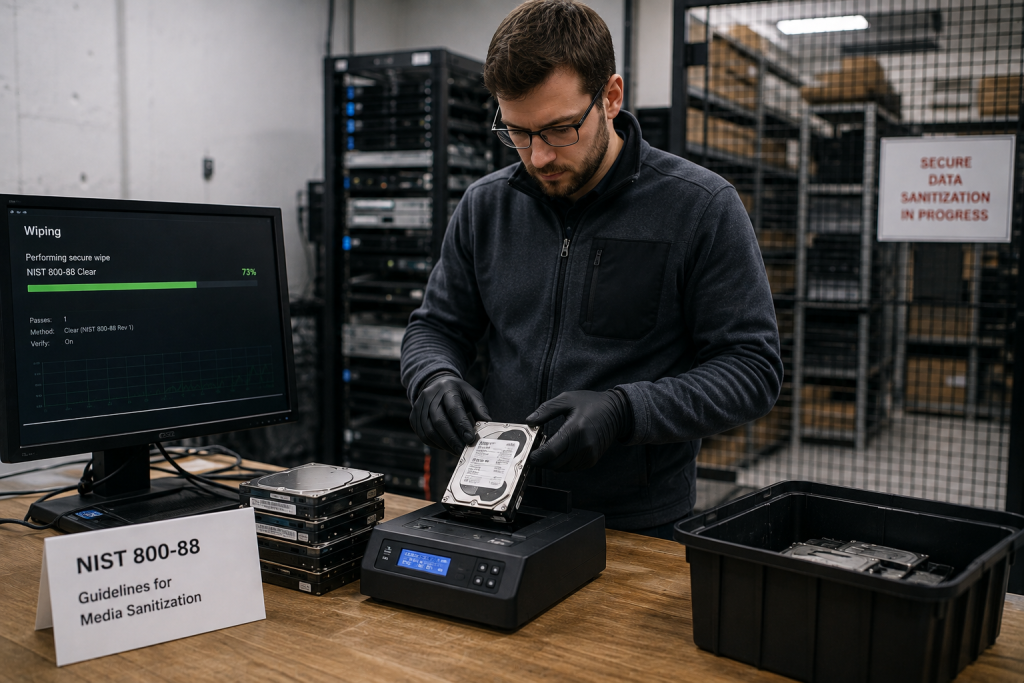
Clearing data is usually software-based. It may overwrite data or use device commands that make prior data unavailable. Clearing may be enough for lower-risk media that stays inside a controlled environment.
For business resale, clearing may not be enough by itself. Your team should confirm whether your policy, contract, or industry rules require a stronger method.
Purge
Purging is stronger than clearing. It may include cryptographic erase, secure erase, block erase, degaussing for magnetic media, or other approved methods based on the media type.
Purge methods are often used when equipment leaves the organization, especially when drives, SSDs, servers, laptops, or storage systems may have stored sensitive data.
Destroy
Destroy means the media is physically damaged so data cannot be recovered. This may include shredding, crushing, disintegration, pulverizing, or other physical destruction methods.
Destroy is common when:
- Drives are failed or unreadable
- Media contains highly sensitive data
- The organization has a destruction-only policy
- The drive cannot be verified after sanitization
- The equipment has no resale value
Destroying storage media may reduce resale value if the drive is part of a larger system, but it may be the right risk decision.
NIST 800-88 and Different Types of IT Equipment
NIST 800-88 applies to more than loose hard drives. Many retired devices can hold data.
Common examples include:
- Laptops and desktops
- Servers
- HDDs and SSDs
- SAN and NAS storage arrays
- Backup tapes
- Mobile devices
- Workstations
- Printers and copiers with internal storage
- Network appliances with configs, logs, or credentials
- External drives and removable media
Before selling equipment, identify every data-bearing asset. A server without drives may be lower risk than a server with a full drive set. A storage array may need drive-level tracking. A laptop may need serialized reporting tied to its internal SSD.
What Documentation Should You Request?
NIST 800-88 is only useful if the process is documented. If your company sells equipment, ask for records that prove what happened.
Useful documentation includes:
- Chain of custody
- Serialized asset report
- Data destruction certificate
- Method used for each asset or media type
- Date of sanitization or destruction
- Technician or facility responsible
- Exception report for failed or missing assets
- Recycling certificate for non-resalable equipment
- Settlement or buyback report
A basic pickup receipt is not enough for a serious ITAD project. You need asset-level records that your compliance, finance, and IT teams can review later.
How NIST 800-88 Supports Buyback Value
Some companies assume secure data destruction means every drive must be shredded. That is not always true.
If equipment is still useful, NIST-aligned sanitization may allow hardware to be resold safely. That can help your organization recover more value from:
- Enterprise laptops
- Servers
- Workstations
- Storage arrays
- Networking appliances
- Mobile devices
- Bulk IT refresh lots
For reusable hardware that is tested and prepared for trusted redeployment, DES Technologies also offers the Phoenix Certified process. This is useful when organizations want secure handling and reliable hardware quality before equipment goes back into service.
The key is to match the data risk to the right process. Some assets can be sanitized and resold. Others should be physically destroyed or recycled.
NIST 800-88 Checklist Before Selling IT Equipment
Use this checklist before you sell used IT equipment:
- Create an inventory of all equipment.
- Identify every data-bearing device.
- Separate drives, SSDs, tapes, and removable media.
- Confirm what data may have been stored.
- Review your internal data destruction policy.
- Decide whether clear, purge, or destroy is required.
- Ask whether the buyer supports NIST 800-88 workflows.
- Request chain of custody documentation.
- Request serialized reporting for larger lots.
- Get a certificate of data destruction when applicable.
- Confirm how failed drives are handled.
- Keep all final reports with your compliance records.
This checklist can help prevent last-minute confusion after equipment has already left your facility.
Common Mistakes to Avoid
NIST 800-88 projects can go wrong when teams treat retired equipment as simple surplus.
Avoid these mistakes:
- Selling equipment before identifying data-bearing media
- Assuming a factory reset is enough
- Forgetting SSDs, tapes, printer drives, or embedded storage
- Mixing sanitized and unsanitized assets
- Accepting a quote without asking about data destruction
- Failing to document chain of custody
- Not tracking failed or missing drives
- Destroying hardware that could have been safely sanitized and resold
The best process protects data first, then recovers value where it makes sense.
How We Buy Used IT Equipment Can Help
We Buy Used IT Equipment works with businesses, data centers, schools, healthcare organizations, government agencies, and enterprise IT teams that need to sell retired hardware securely.
We can help your team:
- Review equipment lists
- Quote bulk IT assets
- Coordinate logistics
- Support secure data destruction
- Provide documentation
- Identify resale value
- Route non-resalable equipment responsibly
If your organization is planning a refresh, decommissioning project, lease return, office cleanout, or storage room cleanup, start with an inventory. Send the make, model, quantity, condition, and storage details. Our team can review the lot and help you understand what has value and what needs secure handling.
FAQ
What is NIST 800-88?
NIST 800-88 is federal guidance for media sanitization. It explains how organizations can clear, purge, or destroy data-bearing media so data cannot be recovered based on the selected method and risk level.
Is NIST 800-88 required by law?
NIST 800-88 is guidance, not a universal law. However, many organizations use it because contracts, regulators, auditors, cyber insurance policies, and internal security teams often expect documented media sanitization.
Is wiping a hard drive the same as NIST 800-88?
Not always. A basic wipe may not meet the correct NIST 800-88 outcome. The method must match the media type, risk level, and reuse or disposal plan. Documentation also matters.
Can I sell equipment after NIST 800-88 data destruction?
Yes. If equipment is properly sanitized and still has market value, it may be sold or reused. If media cannot be sanitized or policy requires destruction, the storage media may need to be destroyed before resale or recycling.
What proof should I get after data destruction?
Request a certificate of data destruction, serialized asset report, chain of custody record, method details, and exception reporting for failed, missing, or destroyed assets.
Get a Secure Quote for Used IT Equipment
NIST 800-88 gives your organization a clear way to manage data risk before equipment leaves your control. We Buy Used IT Equipment helps you turn retired hardware into value while keeping data security and documentation at the center of the process.
Submit your equipment list today to request a quote and discuss secure handling for your used IT equipment.