The best place to sell CPUs and GPUs depends on what you have, how many units you need to move, how fast you want to get paid, and whether the hardware came from business systems. Individual sellers may use public marketplaces. Businesses, data centers, schools, and enterprises usually get better results from a specialized IT equipment buyer that can quote bulk lots, handle logistics, and document the transaction.
CPUs and GPUs can hold strong resale value, especially when they are enterprise-grade, recent generation, clean, tested, and available in matching quantities. Intel Xeon, AMD EPYC, NVIDIA data center GPUs, workstation cards, server pulls, and high-end desktop processors can all attract buyer demand.
We Buy Used IT Equipment purchases used CPUs, processors, GPUs, graphics cards, and full systems from organizations that want fast quotes, secure handling, and simple payment.
Why CPUs and GPUs Still Have Resale Value
Processors and graphics cards are easy to overlook during hardware refreshes. They may sit inside retired servers, workstations, desktops, AI nodes, rendering systems, or storage rooms. But many of these components still have real market demand.
Used CPUs and GPUs may be valuable because they support:
- Server repairs and upgrades
- Refurbished workstations
- AI and machine learning infrastructure
- Rendering and design workloads
- Lab environments
- Legacy platform support
- Gaming and high-performance desktops
- Data center spare parts
- Budget-friendly enterprise deployments
The key is matching your hardware to the right buyer. A single desktop GPU is different from a pallet of server CPUs or a rack of AI GPU systems.
Common Places to Sell CPUs and GPUs
| Selling Option | Best For | Trade-Off |
|---|---|---|
| Public marketplaces | Individual CPUs, gaming GPUs, small lots | More time, buyer risk, fees, returns, and price haggling |
| Local listings | Small consumer parts | Limited buyer pool and more coordination |
| Component brokers | Higher-value parts and mixed lots | Pricing and documentation can vary |
| ITAD companies | Business hardware tied to decommissioning or data destruction | Some focus more on disposal than resale value |
| Specialized IT equipment buyers | Enterprise CPUs, GPUs, servers, workstations, and bulk lots | Best results when you provide clear part details and quantities |
For most businesses, the strongest path is a dedicated IT equipment buyback company. You get a direct quote, clear communication, and fewer moving parts.
When a Specialized Buyer Makes More Sense
If you are selling one gaming GPU, a marketplace may work. If you are selling business hardware, a specialized buyer is usually a cleaner option.
A specialized IT equipment buyer makes sense when:
- You have multiple CPUs or GPUs.
- The parts came from servers or workstations.
- You need a quote quickly.
- You want to sell a mixed lot.
- You have hardware still installed in systems.
- You need pickup or prepaid shipping.
- You need documentation for finance or compliance.
- You are selling as part of a refresh or decommissioning project.
We Buy Used IT Equipment is built for that type of transaction. We buy used CPUs and processors directly through our Sell Used CPUs and Processors page, and we evaluate GPU and high-performance compute hardware through larger data center and enterprise buyback projects.
What Types of CPUs Can You Sell?
CPU resale value depends on generation, model, socket, core count, condition, and current demand. Server-grade processors often perform better than older consumer chips because they support enterprise repair, upgrade, and secondary market needs.
Common CPUs with resale potential include:
- Intel Xeon processors
- Intel Core i5, i7, and i9 processors
- Intel Xeon Scalable CPUs
- AMD EPYC processors
- AMD Ryzen processors
- AMD Ryzen Threadripper processors
- Workstation CPUs
- High-core-count server processors
- Bulk processor pulls from servers and desktops
Intel and AMD product names can be confusing. If you are not sure what you have, send clear photos of the top of the CPU, system labels, or server inventory records. A buyer can often identify the model from the markings.
What Types of GPUs Can You Sell?
GPU value can change fast because demand is tied to AI, data center growth, rendering, design, gaming, and new product cycles. Enterprise GPUs and AI accelerators often need a different sales path than consumer graphics cards.
Common GPUs and accelerator hardware with resale potential include:
- NVIDIA Tesla GPUs
- NVIDIA A100 GPUs
- NVIDIA H100 GPUs
- NVIDIA H200 GPUs
- NVIDIA RTX workstation cards
- AMD Radeon Pro GPUs
- AMD Instinct accelerators
- Intel data center accelerators
- GPU servers and compute nodes
- Graphics cards pulled from workstations
- Bulk GPU lots from refresh projects
High-end GPUs may also require extra review. For example, certain AI accelerators can have export compliance considerations, end-user requirements, and stricter documentation needs. If your lot includes enterprise AI GPUs, work with a buyer that understands business hardware and not just consumer resale.
What Affects CPU and GPU Pricing?
Buyers do not price CPUs and GPUs by name alone. They review the technical details, condition, and resale market.
| Pricing Factor | Why It Matters |
|---|---|
| Model number | The exact model tells buyers the generation, performance tier, and compatibility |
| Generation | Newer CPUs and GPUs often have stronger demand, but some older enterprise parts still sell well |
| Quantity | Larger matching lots are easier to quote and resell |
| Condition | Clean working pulls usually quote better than damaged or unknown parts |
| Form factor | GPU form factors, power needs, and cooling style affect buyer demand |
| Source system | Parts pulled from known servers or workstations can be easier to verify |
| Accessories | Heatsinks, trays, brackets, risers, and power cables may add value |
| Market demand | AI, cloud, workstation, and data center trends can move pricing quickly |
| Documentation | Photos, part numbers, and inventories help buyers quote faster |
For GPUs, memory capacity and form factor matter a lot. A data center SXM GPU, PCIe GPU, workstation GPU, and consumer gaming card can all sell differently.
For CPUs, buyers often look at socket, generation, core count, base frequency, server platform, and part number.
How to Prepare CPUs and GPUs for Sale
Good preparation can help protect value and speed up your quote.
Before you sell CPUs or GPUs:
- Sort parts by model.
- Count quantities by model number.
- Separate CPUs from GPUs.
- Keep protective trays, clamshells, and anti-static packaging.
- Do not scrape, relabel, or clean aggressively.
- Take clear photos of labels and markings.
- Note whether parts were pulled from working systems.
- Include server or workstation model details if known.
- Separate damaged, untested, or unknown parts.
- List any missing brackets, heatsinks, or accessories.
If parts are still installed in servers or workstations, that is fine. We Buy Used IT Equipment can quote full systems, server lots, data center hardware, and component pulls.
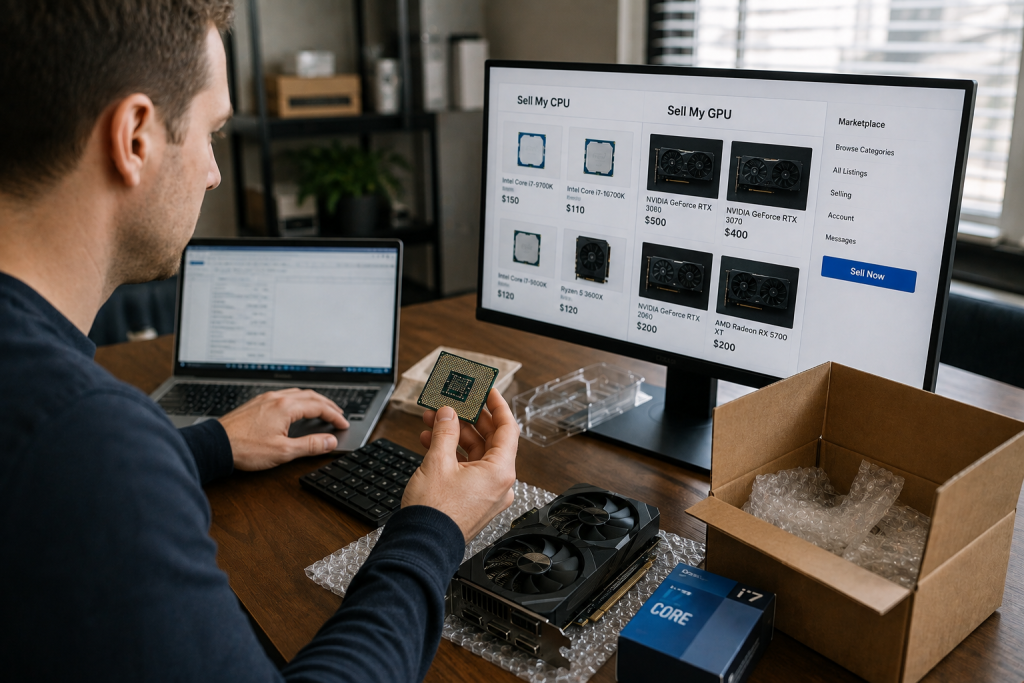
Selling CPUs and GPUs from Data Centers
Data center CPU and GPU lots often have higher value than random mixed consumer parts. That is because enterprise buyers often need matching configurations and platform-compatible hardware.
Data center lots may include:
- Full rack servers
- GPU compute nodes
- AI training systems
- HPC clusters
- Blade servers
- Workstation fleets
- Spare CPU trays
- GPU cards with risers and brackets
- Retired server motherboards
- Mixed component lots
Our Data Center Equipment Buyback page covers larger projects, including GPU and high-performance compute hardware. If your CPUs and GPUs are part of a full decommission, send a rack list, spreadsheet, or rough inventory. We can help review the lot.
Data Security: What Sellers Should Know
CPUs and GPUs are not usually the main data storage risk. The bigger risk comes from the systems they are pulled from, such as servers, storage arrays, laptops, desktops, and drives.
Still, sellers should be careful when components are sold with:
- Hard drives
- SSDs
- NVMe drives
- RAID cards with cache modules
- Servers with local storage
- Workstations with drives
- Storage arrays
- Backup media
If you sell CPUs and GPUs as part of complete systems, make sure data-bearing devices are handled properly. Ask about data destruction, serialized reporting, chain of custody, and final documentation.
How the CPU and GPU Buyback Process Works
Selling CPUs and GPUs to We Buy Used IT Equipment is straightforward.
1. Send Your Inventory
Share the CPU or GPU model numbers, quantities, condition, photos, and whether the parts are loose or still installed.
2. Receive a Quote
Our team reviews current demand and provides a market-based quote. Larger lots may require more detail, but a rough list is enough to start.
3. Ship or Schedule Pickup
Smaller lots may be shipped. Larger business, school, government, or data center projects may qualify for coordinated logistics.
4. Verification and Payment
After the equipment is received and verified, payment is issued based on the agreed process. Clear inventory helps prevent delays.
CPU and GPU Seller Checklist
Use this checklist before requesting a quote:
- Do you have CPU or GPU model numbers?
- How many units are in the lot?
- Are the parts working pulls, new surplus, tested, or untested?
- Are CPUs in trays or still installed?
- Are GPUs PCIe, SXM, workstation, desktop, or server cards?
- Are brackets, risers, heatsinks, or power cables included?
- Are photos available?
- Are any parts damaged?
- Is the lot tied to a larger server or data center project?
- Do any included systems contain data-bearing drives?
- How fast do you want pickup, shipping, and payment?
The more complete the list, the faster your quote.
Where Not to Sell Business CPUs and GPUs
Avoid any buyer or channel that cannot answer basic questions about pricing, logistics, verification, and documentation.
Be careful if a buyer:
- Gives a vague estimate without model details
- Will not explain payment timing
- Cannot handle bulk lots
- Does not know enterprise CPU or GPU models
- Offers no written quote
- Ignores data-bearing equipment in full systems
- Does not provide clear shipping or pickup steps
- Pushes you to ship high-value parts without a clear process
High-value CPUs and GPUs deserve a controlled transaction.
Why Sell CPUs and GPUs to We Buy Used IT Equipment?
We Buy Used IT Equipment helps organizations turn surplus components into recovered value without the time sink of selling one part at a time.
Businesses choose us because we offer:
- Fast quotes for CPUs, GPUs, and full IT lots
- Bulk buyback support
- Enterprise hardware experience
- Clear payment process
- Shipping and logistics support
- Support for servers and data center projects
- Secure handling when parts come with full systems
- Straightforward communication from quote to payment
If you are clearing out a storage room, retiring workstation hardware, upgrading servers, or decommissioning GPU infrastructure, we can help you understand what your CPUs and GPUs are worth.
FAQ
Where is the best place to sell CPUs and GPUs?
The best place depends on your lot size and hardware type. Individuals may use public marketplaces, but businesses usually benefit from a specialized IT equipment buyer that can quote CPUs, GPUs, full systems, and bulk lots.
Can I sell CPUs and GPUs in bulk?
Yes. Bulk CPU and GPU lots are common after server refreshes, workstation upgrades, data center projects, and storage cleanouts. Sorting by model and quantity helps speed up the quote.
What CPU brands have resale value?
Intel Xeon, Intel Core, AMD EPYC, AMD Ryzen, and AMD Threadripper processors may have resale value. Value depends on model, generation, quantity, condition, and current demand.
What GPU brands have resale value?
NVIDIA, AMD, and some Intel GPUs may have resale value. Enterprise GPUs, AI accelerators, workstation cards, and high-end consumer graphics cards often receive stronger demand.
Do CPUs or GPUs store data?
CPUs and GPUs are not usually the main storage risk. The bigger risk is the system they came from, especially hard drives, SSDs, NVMe drives, RAID cards, storage arrays, and backup media.
Get a Quote for Used CPUs and GPUs
If you are asking where to sell CPUs and GPUs, start with a buyer that understands enterprise hardware, bulk lots, and fast payment.
We Buy Used IT Equipment buys processors, graphics cards, GPU systems, servers, workstations, and data center hardware. Send your inventory today and get a clear quote for your used CPUs and GPUs.