Somewhere in a hyperscale data center right now, a rack of NVIDIA H100 servers is being pulled offline. Not because they broke. Because something faster showed up.
That’s the story of AI hardware in 2026. Blackwell-generation B200 systems reached general availability in the first quarter, and hyperscalers are rotating Hopper-generation inventory out to make room. Enterprise operators running air-cooled facilities are retiring H100 clusters that physically can’t host the new liquid-cooled platforms. Co-location tenants are timing GPU fleet retirements around fiscal year planning.
If your organization is sitting on retired A100s, H100s, or the servers that housed them, you’re not alone, and you’re not looking at scrap metal. You’re looking at one of the most active secondary hardware markets in tech. This guide walks through what actually happens to that equipment, what it’s worth, and how to handle the data and compliance side without leaving money or risk on the table.
Why AI Hardware Retires Faster Than Standard Servers
A typical enterprise server runs on a five- to seven-year refresh cycle. AI infrastructure doesn’t get that long.
NVIDIA has moved to an annual architecture cadence: Hopper in 2022, Blackwell in 2024, Rubin arriving in the second half of 2026, and Rubin Ultra slated for 2027. Each generation brings a real performance jump, and in a data center where electricity is the biggest line-item cost, that efficiency gap makes older hardware uncompetitive for frontier training within 18 to 36 months.
There’s also a physical reason. Blackwell’s rack-scale systems run at power densities that older air-cooled facilities can’t support. A cluster doesn’t have to be “worn out” to be retired. It just has to no longer fit the building.
That’s why 2026 is producing what several industry analysts are calling the largest concentrated wave of AI hardware retirement to date: H100s displaced by B200s, A100s aging out of frontier workloads, and Hopper-generation inventory rotating out of hyperscale floor space in bulk.
Retired Doesn’t Mean Worthless: The GPU Value Cascade
Here’s the part that surprises a lot of finance and IT teams: a GPU pulled off a training cluster still has years of useful life left. It just moves to a different job.
Industry analysts describe this as a value cascade:
- Years 1-2: Frontier model training, where raw performance matters most
- Years 3-4: Inference workloads, which are far less demanding on compute
- Years 5-6: Batch processing and analytics, where older hardware still earns its keep
This is why hyperscalers have stretched depreciation schedules from three or four years out to six. Amazon and Microsoft both made this change, and industry estimates put the combined annual depreciation savings across major cloud providers at roughly $18 billion. Hardware that leaves a training floor doesn’t leave the fleet. It gets redeployed, or it gets sold.
That cascade is also why the secondary market has real depth. CoreWeave reportedly rebooked H100 GPUs coming off 2022 contract expirations at 95% of their original pricing, a strong signal that AI accelerators hold value even as newer architectures ship.
What Retired AI and GPU Servers Are Actually Worth
Current secondary market pricing (subject to change as Blackwell adoption accelerates):
NVIDIA H100 80GB
Trading at roughly 60-70% of comparable new pricing through specialist channels. On a 200-unit fleet, that’s the difference between recovering $3 to $4 million through GPU-specialized buyers versus $1.5 to $2 million through a standard, non-specialized ITAD broker.
NVIDIA A100
- 40GB variants: $8,000-12,000 (down from $15,000+ new)
- 80GB variants: $12,000-18,000 (down from $25,000+ new)
- Full 8-GPU server bundles: significant volume discounts available
Warranty transferability matters. A unit with 12 or more months of transferable third-party warranty coverage can trade 8 to 12% higher than an identical unit with expired coverage. If your fleet still has warranty life left, that’s leverage worth using.
Pricing moves fast in this market. B200 availability is already applying downward pressure on H100 values, and historical patterns suggest 10-20% price reductions for previous-generation hardware each time a new architecture reaches volume production. The practical takeaway: the best time to sell is typically six to twelve months before a new generation ships, not after.
Where Does the Money Go? Buyer Types for Retired AI Hardware
Retired GPU servers don’t move through the same channel as a decommissioned file server. The buyer pool looks different:
- Neoclouds and AI infrastructure operators: Companies like CoreWeave, Lambda, and Crusoe are active, well-capitalized buyers of retired hyperscaler H100 fleets, often at prices standard broker channels can’t match.
- Inter-company transfers: Hyperscalers sometimes move fleets internally when configuration and burn-in thresholds are met, rather than selling externally.
- International buyers, in jurisdictions where export compliance has already been verified.
- Mid-market enterprises and universities running inference or research workloads that don’t need frontier-generation hardware.
Standard server resale, by contrast, is a liquid, well-indexed market where dozens of buyers publish pricing and accept consignment. The GPU secondary market is more relationship-driven and time-sensitive. Getting full value usually means working with a partner who already has buyer relationships in place, not listing hardware and waiting.
The Compliance Layer Most ITAD Contracts Miss
Retired AI hardware carries two compliance challenges that standard server disposal doesn’t.
Export Controls (ECCN Classification)
NVIDIA’s H100, H200, B100, B200, and GB200 accelerators fall under U.S. Export Administration Regulations, classified under ECCN 3A090 for the chips and ECCN 4A090 for systems containing them. That means any cross-border handling, including resale to international buyers, processing through overseas ITAD facilities, or even transit through certain jurisdictions, requires export-license review and formal documentation. If your ITAD vendor doesn’t maintain an active export-compliance program, that’s a real exposure, not a formality.
Data Sanitization on HBM Memory
This is the technical detail most enterprise IT teams don’t know until they hit it. NIST SP 800-88, the federal standard most compliance frameworks point to for data destruction, was written before High Bandwidth Memory (HBM) was widely deployed. A retired H100 carries 80GB of HBM3, and that memory is stacked directly on the GPU die. It can’t be removed or degaussed the way a hard drive can.
Sanitizing it correctly requires GPU-specific firmware procedures, not a standard overwrite pass. A server chassis built for AI workloads typically combines GPU HBM memory, NVMe storage, system RAM, and BMC firmware storage, and each of those components needs its own sanitization method assessed against your data’s sensitivity classification. Treating an AI server like a standard rack unit during data destruction is a compliance gap waiting to surface in an audit.
What This Means Practically
- Ask any ITAD partner directly whether they perform GPU-specific memory sanitization, not just drive-level wiping
- Look for NAID AAA and R2v3 certification, which cover both destruction process integrity and downstream materials handling
- Require serialized, per-GPU chain-of-custody documentation, not a single certificate covering an entire pallet
- If your fleet processed regulated data under HIPAA, GLBA, CMMC, or similar frameworks, confirm your vendor can produce per-device sanitization certificates, not blanket paperwork
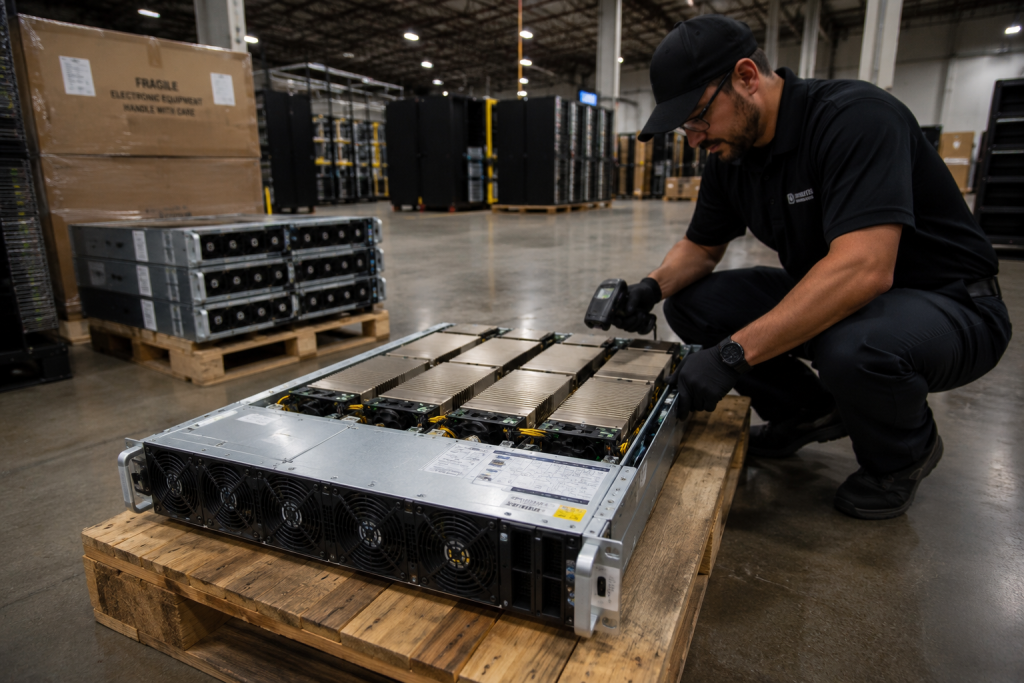
How Retired AI Servers Move Through Disposition
The general workflow looks like this, whether you’re retiring five GPUs or five hundred:
- Intake and serialized inventory: Every accelerator is logged by serial number, model, and memory generation before anything else happens.
- Data classification: Each system is evaluated for the sensitivity of the data it processed, which determines the required sanitization level.
- Sanitization or destruction: GPU-specific procedures are applied to HBM memory, alongside standard NIST 800-88 methods for drives and system RAM.
- Grading and routing: Functional units are tested and graded for resale value; anything that can’t be resold is routed to certified recycling.
- Remarketing: Graded units are placed with vetted buyers, whether that’s a neocloud operator, an inference-focused enterprise, or an international buyer with cleared export status.
- Reporting: You receive documentation covering both the financial outcome and the compliance trail for every serialized asset.
Skipping steps here doesn’t just cost money. It’s how enterprises end up with a written-off, physically destroyed GPU fleet when a portion of it could have been resold for six figures.
Should You Sell, Redeploy, or Destroy?
Not every retired GPU should go straight to a buyer. A quick way to think about it:
- Redeploy internally if you have inference or research workloads that don’t need frontier-generation performance. This is often the highest-value option and avoids resale friction entirely.
- Sell if the hardware has clean data sanitization documentation, functional test results, and no regulatory hold on the data it processed.
- Destroy if the data classification requires it, or if physical damage makes resale impractical. Physical destruction forfeits real value on functional GPUs, so this should be a deliberate decision, not a default.
Why Timing Your Sale Matters More With AI Hardware Than Standard Servers
Standard enterprise servers depreciate on a fairly predictable curve. GPUs don’t. Because NVIDIA ships new architectures annually now, resale values can compress quickly once a successor generation reaches volume availability. Waiting a year to sell a retired H100 fleet after B200 adoption ramps up will almost certainly net less than selling it during the transition window. If you know a refresh is coming, start the disposition conversation before the new hardware lands, not after.
Get a Quote on Your Retired AI and Data Center Hardware
Retired AI servers and GPUs are not a liability sitting in a rack. They’re recoverable capital, provided the data destruction, compliance documentation, and buyer relationships are handled correctly.
We Buy Used IT Equipment works with enterprises, data centers, and co-location tenants retiring GPU fleets, servers, and the components inside them. Our process includes serialized asset tracking, NIST 800-88 aligned data destruction, and R2v3-certified downstream handling, backed by DES Technologies’ ITAD infrastructure
Frequently Asked Questions
Can retired NVIDIA H100 or A100 GPUs be resold?
Yes. Retired H100 and A100 GPUs are actively traded on the secondary market, typically through specialist buyers rather than general IT liquidators. H100 units currently trade at roughly 60-70% of new pricing through these channels, provided data sanitization and export compliance are handled correctly first.
How much is a retired AI server worth in 2026?
Value depends heavily on GPU generation, memory configuration, and remaining warranty. A100 80GB units are trading between $12,000 and $18,000, while H100 units retain a significantly higher percentage of original value due to strong demand from neoclouds and inference-focused buyers. Getting an accurate quote requires evaluating the specific configuration and condition.
Is it safe to sell a GPU server that processed sensitive data?
It can be, once the hardware goes through proper sanitization. Because GPU memory (HBM) is stacked on the chip and can’t be degaussed like a hard drive, it requires GPU-specific firmware sanitization procedures, not a standard drive wipe. A qualified ITAD partner should confirm this is complete, and provide serialized documentation, before any resale occurs.
Do export controls affect the resale of AI GPUs like H100 or B200?
Yes. These accelerators fall under U.S. export control classifications (ECCN 3A090 for the chips and 4A090 for systems containing them), which means any international resale, cross-border shipping, or offshore processing requires export-license review. Work with a vendor that maintains an active export-compliance program.
When is the best time to sell retired GPU hardware?
Generally, six to twelve months before the next architecture generation reaches volume availability. Resale values for previous-generation GPUs tend to compress once buyers can access the newer platform, so waiting until well after a new release typically reduces what you recover.