Earlier data were recorded on pen and paper and used to get transferred through the hands of people. For confidential data, trustworthy personnel were selected for transferring of data. Details about the time of exchange of documents were kept secret and the documents were sealed with melted wax to protect them from thieves.
Now doing the same thing now will make those workers lose all their hair. Not to forget the coding, software, and data about people traveling on a daily basis, exchanging conversations over social networking websites.
So, just like that, businesses and organizations have their individual data having details about their businesses which needs to be maintained. It is necessary and also helpful to have a data lifecycle to have more analyses, discoveries, and more due to access to large data sets.
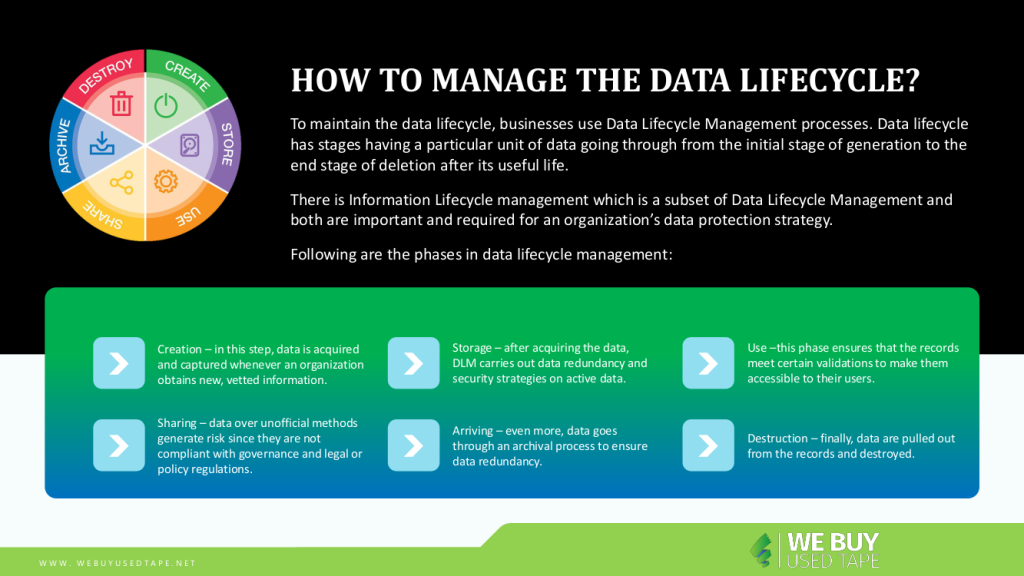
To maintain the data lifecycle, businesses use Data Lifecycle Management processes. Data lifecycle has stages having a particular unit of data going through from the initial stage of generation to the end stage of deletion after its useful life.
Data Lifecycle management can be therefore used to maintain the lifecycle of data but how? Let’s see.
What does Data Lifecycle Management do?
It involves the processes, policies, and procedures required to manage business data of an organization within it during its lifetime starting with creating or beginning of data till it’s no longer required. It is a policy-based system monitoring its operation which helps to manage the incoming and outgoing of information during its useful lifetime throughout various applications, systems, databases, and storage media.
There is Information Lifecycle management which is a subset of Data Lifecycle Management and both are important and required for an organization’s data protection strategy.
In Data Lifecycle Management, data are protected, preserved, and managed. To make the process more complex, these above-mentioned things need to be carried out under complex regulations and that too in several places. The regulations need to be followed in the places where the organization’s data are like in the premises or off the premises such as in the cloud, in remote workforce machines, etc. DLM also helps businesses to remain updated on any evolving regulations and eDiscovery requirements.
DLM helps the organizations to have control over their large number of data allowing the organization to fulfill their archiving needs, lessening the burden for IT professionals. This way, businesses can see a reduction in their storage costs, enhancing faster decision-making by improving the processing efficiency and fast recovery during an event of an emergency.
Following are some features of DLM:
DLM allows data to be more easily accessible, clean, and usable. Therefore, data-driven processes will be able to carry out more effectively thus the organization will be able to achieve higher agility and control over data.
DLM confirms that the data created or collected will be kept safe. This is possible as, under DLM regulations, it mentions the ways the data will be processed, stored, and shared which ensures the users’ data are protected by preventing the data from breaches, losses, and risk of data deletion.
Every business is different and thus has different conditions for data retention. Using DLM in businesses will ensure that the company’s data are compliant with the laws and regulations all around the world. There are compliance regulations that need to be adhered to by the companies which regulate the ways in which the organization should deal with particular types of data. If companies do not follow, then that will lead to non-compliance citations and penalties.
Companies also face great advantages when using DLM.
Following are some benefits of DLM that are enjoyed by the companies:
It helps in reducing costs or effectively using the resources. Sometimes data that is not being frequently used or doesn’t have much value remains stored in storage which can either be in high-end resources which are definitely not necessary. DLM shifts these types of data when they are not in use to a different location. Data can be transferred to the cloud or in a hosted off-site tape vault. This way the data required frequently can be easily accessed and the storage will be better utilized.
In today’s world, everything is wanted quickly. Quick access, quick payments, quick updates. To provide customer quick service, the process of acquiring data or searching of data and delivering of data needs to be quick. This way, workers to users remain productive and this is what DLM delivers. Through DLM, data can be acquired as and when required and thankfully eliminates data that will prevent essential business collaboration. When data are extracted and maintained during the whole time through the data lifecycle, values are effectively updated and always available.
Securing data is very crucial and it is no secret now. We hear small to large breaches and from small big companies, every company gets affected by it. DLM incorporates data protection being its core capabilities which in turn will protect the data infrastructure.
DLM strategy helps to maintain tagged and indexed data so that they can be accessed whenever required. DLM strategy will work with IT to bring new policies and procedures for the same. When data are established through governance policies, it protects the data for the future since the data can be retained as long as required. It is beneficial to have clean, useful, and precise data as these will enhance the users’ experience increasing the agility and efficiency of the company process.
- It recognizes and reduces process and data bottlenecks.
- It keeps redundancy under check by carrying out accurate identification of duplicate records.
- It is capable to run root-cause analysis.
- DLM is able to trace data lineage across the customer demographic lifecycle.
- It increases efficiency in managing historical data.
- It helps in reducing unwanted changes to data content.
- It also develops better consistency, reliability, and access to needed data.
- For the companies to have these benefits, DLM follows a process.
Following are the phases in Data Lifecycle Management:
Creation – in this step, data is acquired and captured whenever an organization obtains new, vetted information. The information could include creating data internally, purchasing third-party data, and collecting data as it streams. It handles every format of data.
Storage – after acquiring the data, DLM carries out data redundancy and security strategies on active data. This step prevents data from being altered accidentally. This is the time when the data gets secured so that it can be accessed by those who are authorized. This will help the organization to protect its intellectual property along with its customer relationships. This phase is also crucial since it is not only important to have a place to store but also it should be possible to retrieve the data if lost and DLM is capable of data recovery plans.
Use – further in the phase, this phase ensures that the records meet certain validations to make them accessible to their users based on some definitions given by DLM.
Sharing – data are shared on a daily basis. Data can be shared with someone who is from the organization to another person from the organization but data can also be shared with another person who does not belong to the organization. Sharing data over unofficial methods generate risk since they are not compliant with governance and legal or policy regulations.
Arriving – even more, data goes through an archival process to ensure data redundancy. This is an ideal storage method that helps organizations to store huge amounts of data and allow the organizations to access the information when required.
Destruction – finally, data are pulled out from the records and destroyed.