Short answer: Data center equipment recycling is the secure retirement of servers, storage, networking, and power gear. A certified provider inventories every asset, erases or destroys its data to NIST SP 800-88 Revision 2, resells or refurbishes what has value, recycles the rest through R2v3-certified channels, and gives you chain-of-custody records and Certificates of Data Destruction.
Start here: See everything we offer data center teams on our data centers page, or send us a list for a quote on a full data center lot.
In this guide: What gets recycled · The four steps · Proof you should get · Questions to ask a recycler · Why it matters · FAQ
What Counts as Data Center Equipment?
The term covers more than servers. Here’s how each type is usually handled:
| Equipment | Data Risk | Typical Path |
|---|---|---|
| Servers and storage arrays | High: drives, memory, management controllers | Sanitize or destroy the data, then resell, harvest parts, or recycle |
| Network switches, routers, and firewalls | High: configurations, credentials, keys | Sanitize onboard storage, then resell or recycle |
| Backup tape | High: full copies of your data | Degauss or shred, or sell if the data is properly handled first |
| Racks, cabinets, and cabling | None | Resale or metal recycling |
| UPS units and batteries | None, but hazardous | Specialized battery recycling with documentation |
| Cooling equipment | None | Specialist handling, because refrigerants require licensed handling |
Data-bearing gear needs a security plan. Hazardous gear needs a handling plan. Most projects include both.
Recycle or Sell? In Most Data Centers, Both
“Recycling” isn’t always step one. Servers, memory, drives, and networking gear often have resale value, and selling them recovers money before anything gets scrapped. According to recent market reports, server memory prices roughly doubled this year, and industry benchmarks show server resale values running well above their long-term averages. AI environments also refresh hardware faster, with some industry sources reporting cycles of 18 to 36 months, so retired gear arrives sooner than it used to.
The right approach evaluates first, then decides item by item what gets resold, what gets parts harvested, and what gets recycled.
The Four Steps
1. Get a Valuation and a Plan
Send us your inventory, including make, model, configuration, condition, accessories, and quantity. We review it against current market conditions and send a clear, no-obligation quote. The quote is only as accurate as your list, so more detail means a better number. See what we buy!
2. Secure Pickup and Chain of Custody
Equipment is tagged, scanned, and moved with a documented chain of custody. For large projects, our partner DES Technologies offers hardware removal, data center decommissioning, and on-site services.
3. Data Destruction
Every data-bearing device is processed to NIST SP 800-88 Revision 2, which replaced Revision 1 in September 2025. The method depends on the device:
- Certified erasure for equipment headed to resale.
- Degaussing for magnetic media like hard drives and tape. It typically leaves the media unusable.
- Physical destruction, such as shredding, for damaged devices and highly sensitive data.
SSDs need a verified cryptographic or manufacturer secure erase, or destruction, because overwrite tools built for hard drives don’t reliably sanitize flash storage. Our a explains why.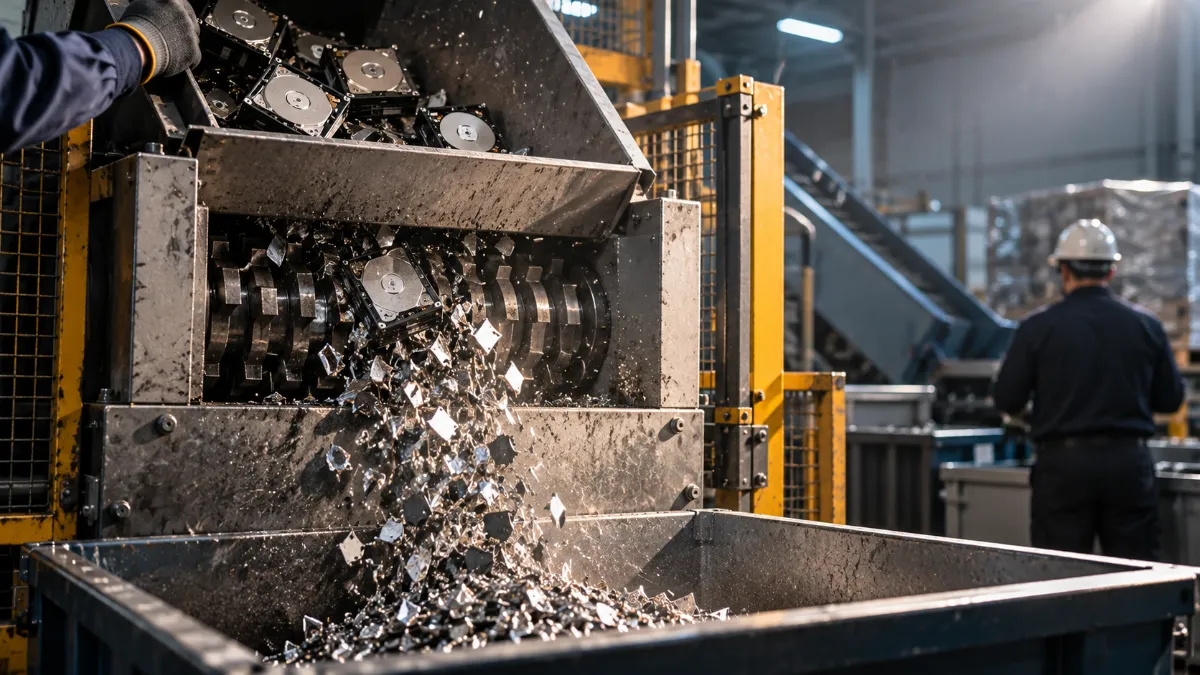
4. Resale, Recycling, and Reporting
We test and grade equipment. Units with value are refurbished and resold. Everything else goes to responsible recycling, where metals, plastics, and components are recovered instead of landfilled. Our partner DES handles electronics recycling under R2v3 certification. Then you get your paperwork.
The Proof You Should Get
Ask for all of these:
- A Certificate of Data Destruction with each device’s serial number, the method, the date, and the standard followed. See our Certificate of Data Destruction guide.
- Chain-of-custody records from pickup to final disposition.
- Recycling documentation showing where materials went.
- A resale statement, if equipment had value.
This paperwork is what auditors, regulators, and insurers look for. For tape, see our guide to chain of custody for LTO and 3592 tapes.
Questions to Ask Any Data Center Recycler
- Which certifications do you hold, and can you show current documentation?
- How do you track each asset from pickup to final disposition?
- How do you handle SSDs, tape, and network devices?
- Do you provide a Certificate of Data Destruction with serial numbers?
- Where does recycled material end up, and who are your downstream partners?
- How do you handle batteries, UPS units, and cooling equipment?
- Can you evaluate resale value before recycling anything?
- Can you give references?
Our references page shows who we’ve worked with, and our partner’s ITAD vendor checklist goes deeper. Check DES’s certifications page for the current list.
Why It Matters
Data security. IBM’s 2025 Cost of a Data Breach Report puts the global average cost of a breach at $4.44 million, and $10.22 million in the United States. Studies of resold drives keep finding recoverable data. A 2019 University of Hertfordshire study commissioned by Comparitech found that 59% of 200 used drives had not been properly wiped.
The environment. The UN’s 2024 Global E-waste Monitor found that the world generated 62 million tonnes of e-waste in 2022, and only 22.3% was documented as properly collected and recycled. It projects 82 million tonnes by 2030. Enterprise hardware contains metals worth recovering and materials that don’t belong in landfills.
Compliance. Rules vary by industry and location, but the common thread is proof. If you can’t show what happened to your data and equipment, you can’t defend it in an audit.
Frequently Asked Questions
What is data center equipment recycling?
It’s the secure retirement of servers, storage, networking, and power gear. It includes data destruction, resale or recycling, and documentation.
Is recycling the same as secure disposal?
No. Recycling recovers materials. Secure disposal covers the whole process, including destroying data first and documenting that it happened.
Can I get paid for old data center equipment?
Often, yes. Servers, memory, drives, networking gear, and tape frequently have resale value. We evaluate before we recycle.
How is data destroyed?
By certified erasure, degaussing, or physical destruction, following NIST SP 800-88 Revision 2, depending on the device and how sensitive the data is.
What happens to UPS batteries and cooling equipment?
They need specialized handling. Batteries are hazardous and need documented recycling, and refrigerants in cooling equipment require licensed handling. Ask any provider how they manage them.
What documents will I receive?
A Certificate of Data Destruction with serial numbers, chain-of-custody records, recycling documentation, and a resale statement if your equipment had value.
Do you handle large decommissioning projects?
Our partner DES Technologies offers data center decommissioning, hardware removal, and on-site services. See our guide to data center relocation and liquidation for how to plan one.
Ready to Retire Your Data Center Equipment?
Get a free quote and find out what your equipment is worth, and how we’ll protect your data.