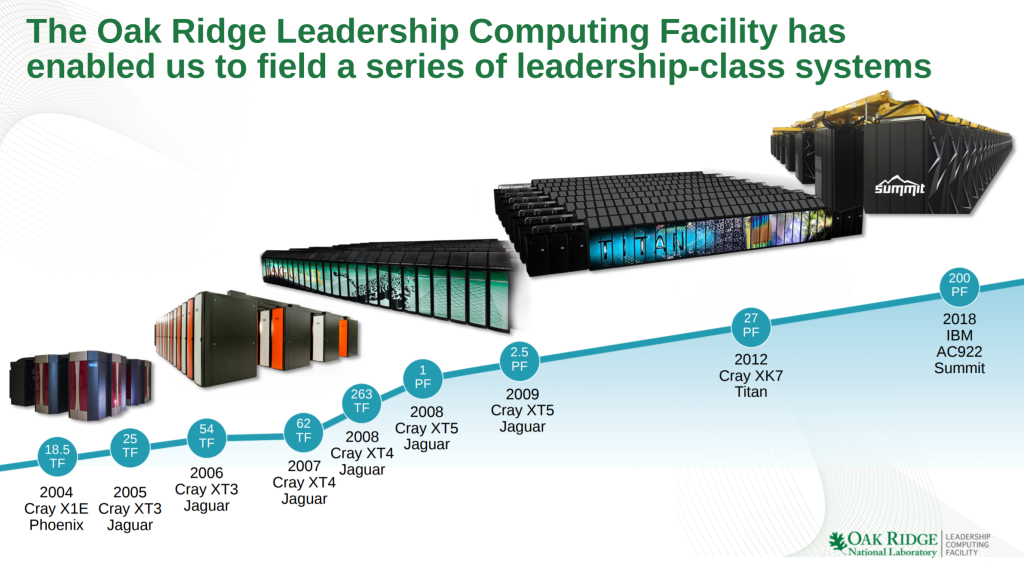
Imagine a single computer so advanced in power and efficiency that it’s a million times more powerful than a high-end laptop, allowing it to sift through thousands and thousands of variables and create models and simulations to help find answers to the world’s most complex problems. Meet Summit, a supercomputer developed by IBM for use at Oak Ridge National Laboratory, capable of solving an estimated 200 quadrillion calculations (200 petaFLOPS) per second.

In November 2014, the United States Department of Energy awarded a $325 million contract to IBM, NVIDIA, and Mellanox. The contract launched the multi-year development of the Summit computer. The Summit supercomputer was developed for civilian scientific research and is located at the Oak Ridge National Laboratory in Tennessee. The Summit supercomputer provides scientists and researchers the opportunity to solve complex tasks in the fields of energy, artificial intelligence, human health, and other research areas. Recently, it was used in Earthquake Simulation, Extreme Weather simulation using AI, Material science, Genomics, and in predicting the lifetime of Neutrinos in physics.
Summit is based on a primarily new architecture led by IBM, where compute power is embedded everywhere data resides. The supercomputer combines some of the world’s most powerful central processing units (CPUs) with graphics processing units (GPUs) optimized for scientific and artificial intelligence workloads, all connected with lightning-fast networking.
How Powerful is IBM’s Summit Supercomputer? Take a closer look at Summit by the numbers.

Summit Joins the Fight Against COVID-19
With a world-renowned supercomputer capable of providing scientists and researchers the opportunity to solve complex tasks in the field of human health, it only makes sense to bring it to the forefront in the fight against COVID-19. Technology has been at the center of scientific advances for decades. That’s why the US Dept of Energy announced a powerful new ally in the fight against the COVID-19 epidemic that has swept through 84 countries.
Viruses work by infecting cells, injecting their genetic material into the host cell. When trying to understand new biological viruses work, researchers grow the micro-organism and see how it reacts in real-life to the introduction of new compounds. Unfortunately, this can be an extremely slow process. Computers can perform digital simulations to narrow down the range of potential variables and examine how those variables react with different viruses.
What’s the Latest with Edge Computing and Why it Should Matter to You
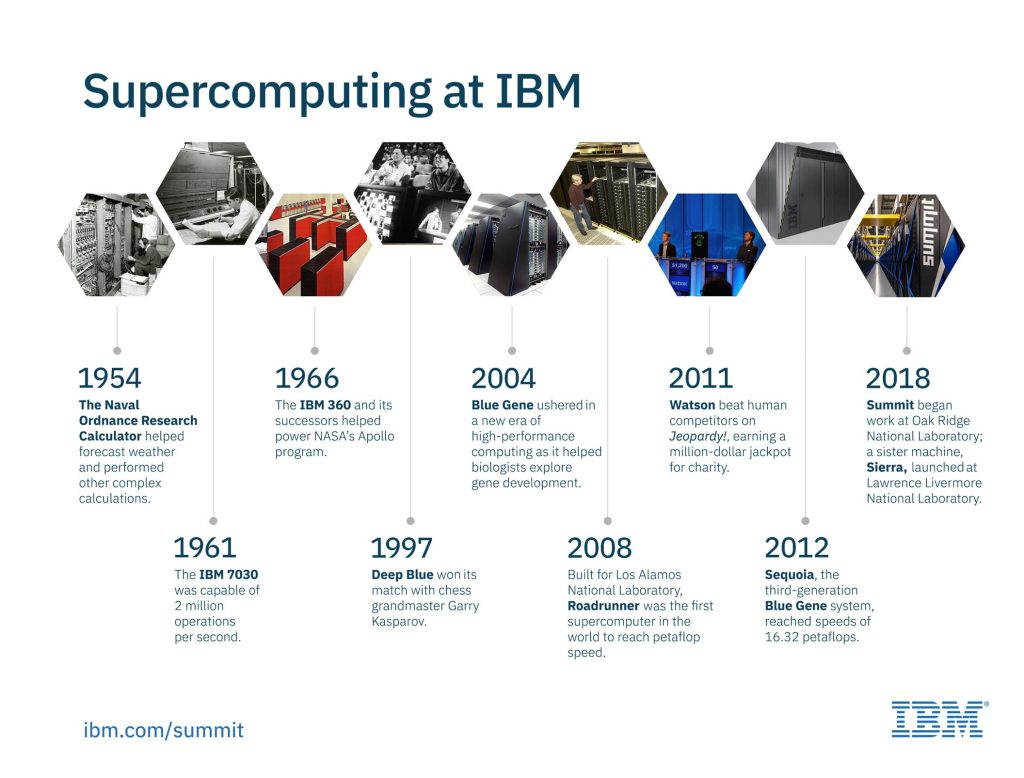
With the help of Summit, researchers were able to simulate 8,000 compounds in a matter of days. Summit drove rapid scientific research in identifying 77 small-molecule compounds, such as medications and natural compounds, proven to potentially weaken COVID-19.Since its unveiling as the world’s most powerful supercomputer, Summit has reinforced its title by driving innovative research from helping to understand the origins of the universe, helping to understand the opioid crisis, and simulating how humans can eventually land on Mars. Summit, and its sister supercomputer Sierra, were produced at the same time by IBM. This is an unparalleled feat that is evidence of the commitment of IBM enthusiasts and their partners. Summit continues to lend its weight in this latest pursuit of providing ground-breaking technology for the betterment of humankind.

IBM Summit Specs:
- 200 quadrillion calculations per second
- 250 petabytes storage capacity
- 9,216 IBM POWER9 CPUs
- 25 gigabytes per second between nodes
- 27,648 NVIDIA Tesla GPUs